Brazilian Federal Police Seek Mastermind Behind 3.7-Ton Cocaine Haul Intercepted at Sea
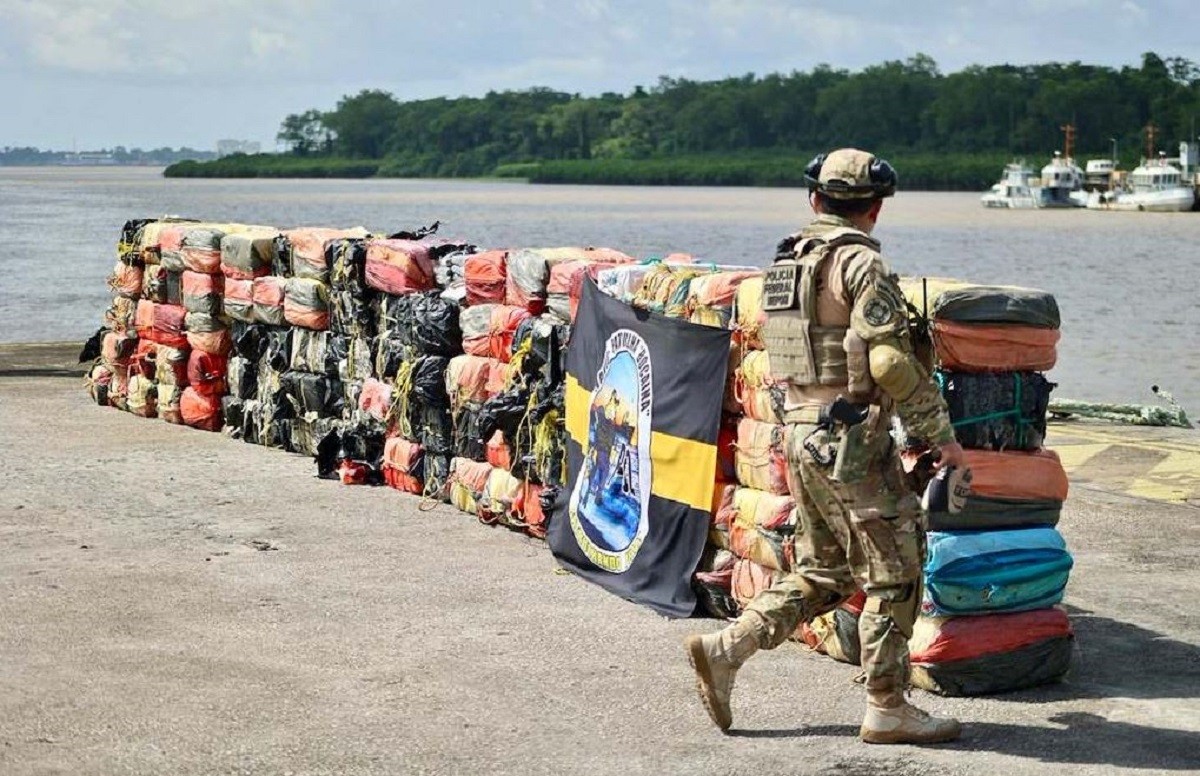
Brazilian Federal Police (PF) and the Navy have intercepted a fishing vessel in international waters carrying nearly four tons of cocaine. The operation, which took place approximately 1,500 kilometers off the coast of Pará state, resulted in the seizure of 3,748 kilograms of cocaine, packaged in over 100 bundles hidden in the boat's hull. Four individuals have been arrested in Belém on suspicion of international drug trafficking. Authorities had been monitoring the vessel since April, thanks to intelligence shared by national and international agencies, including the U.S. Drug Enforcement Administration (DEA) and the Joint Interagency Task Force South (JIATF-South). The PF's Regional Superintendent, Alexandre de Andrade Silva, stated that investigations are ongoing to identify the main distributor of this significant drug quantity, involving analysis of seized materials and suspects' mobile phones. The wooden fishing boat is believed to have departed from Pará, possibly assembled there, with an intended destination of Guinea, Africa. However, investigators suspect the drugs were loaded en route. The vessel was reportedly stationary for an extended period before proceeding to its destination. The Navy's patrol ship Bocaina towed the intercepted vessel back to Belém, a journey that took nearly a week. Officials note that Pará's strategic location makes it a key route for drug trafficking to Africa, Asia, and Europe, utilized by criminal organizations for its speed and cost-effectiveness.
This interdiction highlights the sophisticated international cooperation required to combat transnational drug trafficking networks. The extensive monitoring period and involvement of multiple U.S. agencies underscore the global nature of the drug trade and the intelligence-sharing mechanisms employed to disrupt it. The PF's focus on identifying the 'master distributor' points to the hierarchical structure of these organizations, where disrupting leadership is a key objective. Pará's role as a strategic transit point illustrates how geographic advantages can be exploited by illicit actors, necessitating continuous adaptation of law enforcement strategies. The investigation's reliance on analyzing seized digital devices and the vessel's movements reflects the evolving technological landscape of both criminal operations and counter-narcotics efforts.
AI-generated to prompt reflection — not editorial opinion, not advice, not a statement of fact. How this works.