Brazilian Governors' Approval Ratings Show Stability, Except for Rio de Janeiro
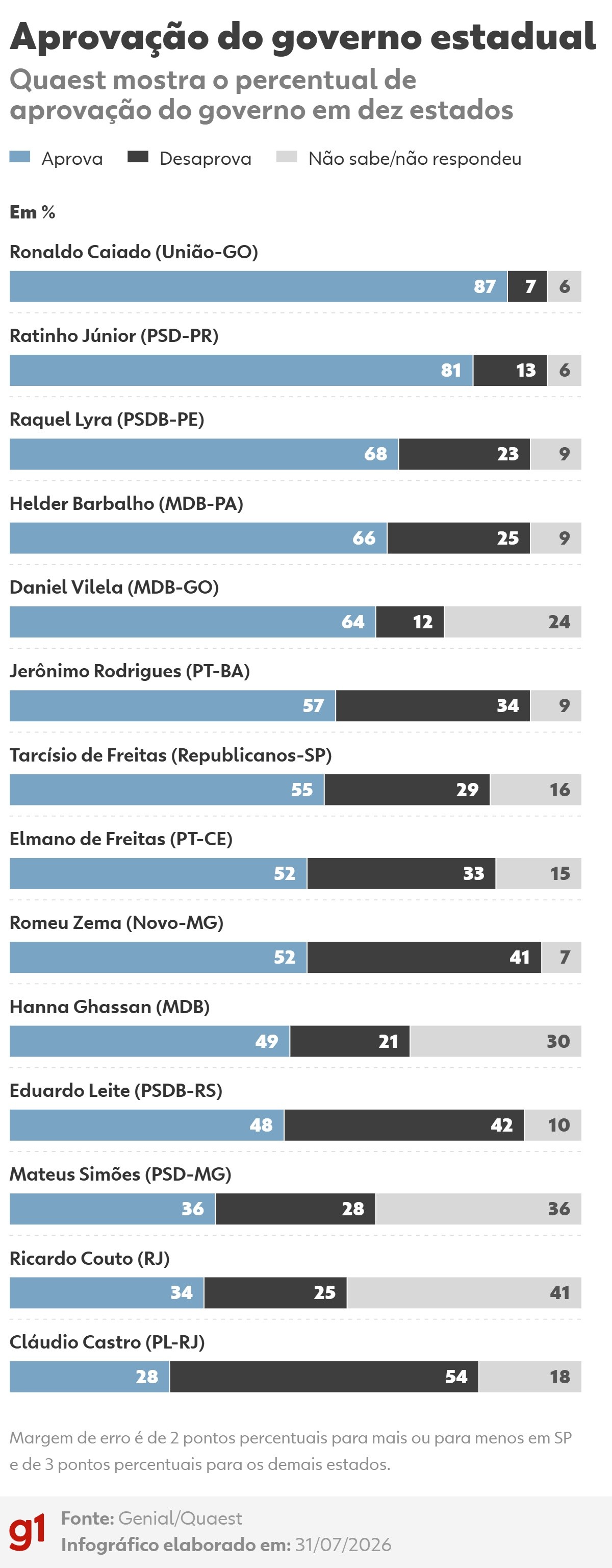
A July 2026 Quaest poll assessing the performance of governors and former governors across 10 Brazilian states reveals a landscape of relative stability, with Rio de Janeiro being a notable exception. While approval ratings for most of the surveyed governors saw only minor fluctuations from April, Cláudio Castro of Rio de Janeiro became the sole former governor in the survey to have more disapproval than approval, registering a negative balance of 26 percentage points. In Goiás, former Governor Ronaldo Caiado (União) maintained a leading position with 87% approval and 7% disapproval, an improvement from April. His successor, Daniel Vilela (MDB), garnered 64% approval and 12% disapproval. Paraná's Governor Ratinho Júnior (PSD) also showed strong performance with 81% approval. In Pernambuco, Governor Raquel Lyra (PSDB) experienced significant growth, increasing her approval from 62% to 68% while her disapproval dropped from 35% to 23%. Pará's Governor Hana Ghassan, who took over from Helder Barbalho (MDB), received 49% approval and 21% disapproval. São Paulo's Governor Tarcísio de Freitas (Republicanos) remained stable at 55% approval, though down from earlier highs. Bahia's Governor Jerônimo Rodrigues (PT) has 57% approval, with 52% believing he deserves re-election, yet only 21% want the next governor to continue his current work. Ceará's Governor Elmano de Freitas (PT) holds 52% approval, showing a stark polarization with 77% approval among 'lulistas' and 67% disapproval among 'bolsonaristas'. Minas Gerais' Governor Romeu Zema (Novo) maintained 52% approval, while his successor, Mateus Simões, has 36% approval. Rio Grande do Sul's Governor Eduardo Leite (PSDB) saw a slight decline to 48% approval, continuing a downward trend.
The reported approval ratings offer a snapshot of public sentiment towards state leadership in Brazil, highlighting varying degrees of public confidence and potential challenges for incumbents and their successors. The divergence in approval trends, particularly the decline in Rio de Janeiro and the growth in Pernambuco, suggests that state-specific factors, policy outcomes, and political maneuvering are significant drivers of public perception, rather than a uniform national mood. The polarization evident in states like Ceará and Minas Gerais, tied to national political alignments, indicates that sub-national governance is increasingly influenced by broader ideological divides. Future governance strategies may need to address these deep-seated divisions while navigating the complex interplay between executive performance, electoral mandates, and the public's desire for continuity versus change.
AI-generated to prompt reflection — not editorial opinion, not advice, not a statement of fact. How this works.