Brazilian Party Presidents Earn Up to $52.5K Monthly from Public Funds
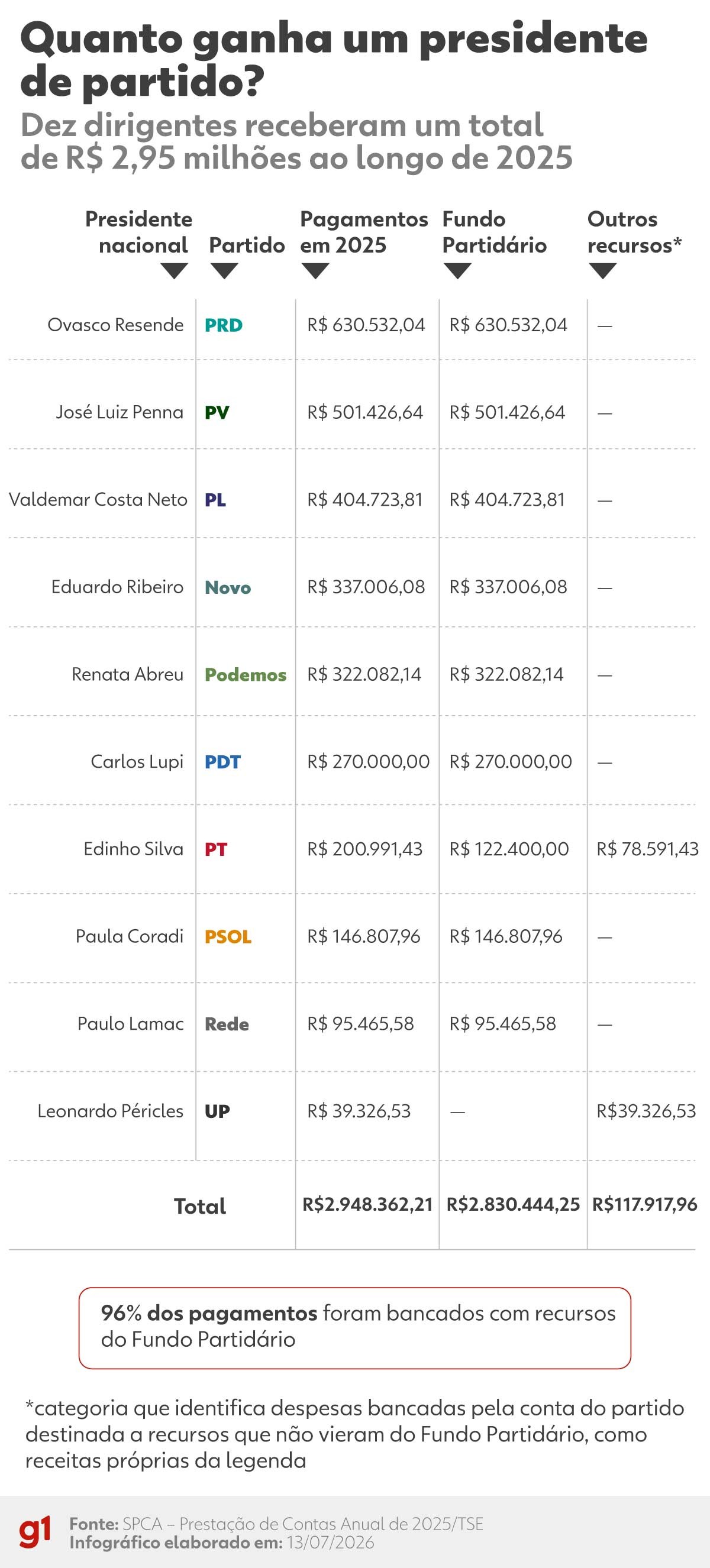
A recent investigation by g1, based on financial reports submitted to Brazil's Superior Electoral Court (TSE), reveals that national party presidents received substantial payments, amounting to as much as R$ 630,500 annually in 2025. This translates to a monthly income of approximately R$ 52,500. The study analyzed 30 registered political parties, focusing on expenses by national directorates on behalf of their current presidents. Ten party leaders were identified as receiving payments categorized as salaries, personnel expenses, or technical-professional services, collectively earning R$ 2.95 million in that year. A significant 96% of these funds originated from the Party Fund (Fundo Partidário), with the remaining R$ 117,900 coming from the parties' own resources or other sources. The Party Fund is primarily financed by public money from the Union Budget, supplemented by electoral fines, donations, and other legally defined revenues, which parties can use for their operational activities, including personnel and service costs. Ovasco Roma Altimari Resende of the PRD party received the highest reported amount, R$ 630,500, entirely from the Party Fund. José Luiz Penna, president of the PV party, followed with R$ 501,400, also fully funded by the Party Fund. Electoral law experts note that while there isn't a specific legal ceiling for party president salaries, parties must adhere to general payment limits outlined in the Law of Political Parties. Some argue for applying the constitutional salary cap for public officials, which is currently R$ 46,366.19 monthly, though this doesn't automatically apply to party leaders. Payments can be classified as personnel expenses or technical-professional services, depending on the leader's role, such as providing accounting, consulting, or legal services.
This report highlights a significant financial flow within Brazilian political parties, where a substantial portion of leaders' compensation is derived from public funds. The practice raises questions about the allocation of resources intended for party operations and public engagement versus direct remuneration for leadership roles. While legal frameworks permit the use of the Party Fund for personnel and services, the scale of payments to top officials, particularly when exceeding the constitutional salary cap for public servants, warrants scrutiny regarding transparency and accountability. The system's reliance on public financing for these high stipends, especially in a context where parties are meant to represent diverse public interests, invites consideration of potential incentive structures that may prioritize internal compensation over broader societal needs or effective governance. Future considerations should explore mechanisms to ensure public funds are demonstrably used for democratic processes and party development, rather than private enrichment, aligning with the evolving demands for financial integrity in political organizations.
AI-generated to prompt reflection — not editorial opinion, not advice, not a statement of fact. How this works.