Brazilian Police Arrest Seven in Money Laundering Operation Linked to PCC and US Sanctions
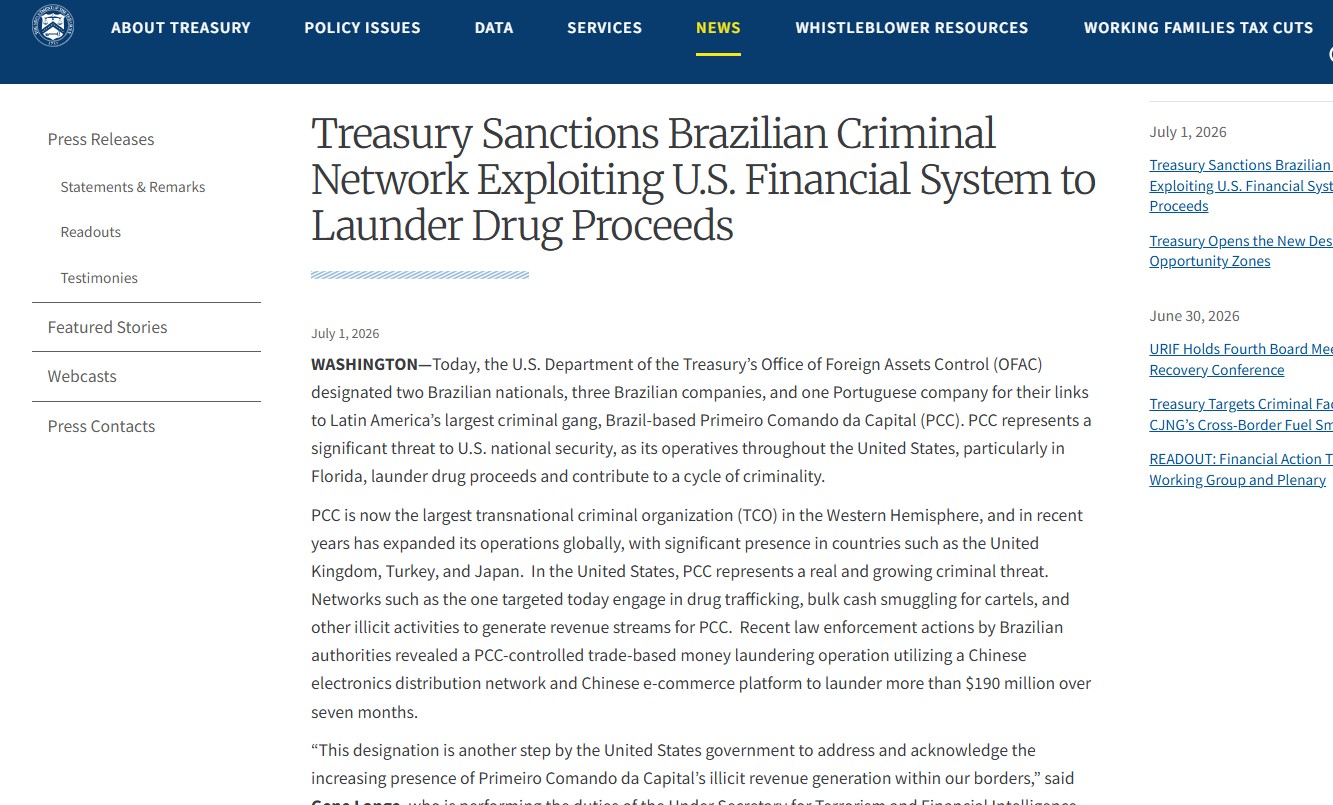
Brazilian Federal Police launched "Operation Exchange" on Friday, March 3rd, targeting money laundering activities. The operation resulted in 11 arrest warrants, with seven individuals apprehended by the time of reporting. Among those arrested is Stella Stefanie Nunes Henrique de Oliveira, who was recently sanctioned by the U.S. on March 1st for alleged ties to the powerful criminal organization Primeiro Comando da Capital (PCC). All detainees are being transferred to the Federal Police headquarters in São Paulo.
Businessman Victor Henrique de Oliveira Shimada, also subject to U.S. sanctions, is among those sought by the police but remains at large. U.S. sanctions involve blocking assets within the United States and any company owned 50% or more by the sanctioned individuals. Shimada, a partner in Victory Trading Intermediação de Negócios Cobranças e Tecnologia Ltda and Avenidas Flutuantes Unipessoal Lda (based in Portugal), is accused by the U.S. of laundering over $30 million in illicit funds generated in the U.S. using cryptocurrency to transfer money back to Brazil for the PCC. He is also investigated in Brazil for alleged involvement in money laundering related to the VaideBet case, which scrutinizes fund diversions from a sponsorship contract with the Corinthians football club.
While the investigation does not explicitly state Shimada is a PCC member, it suggests he is part of a financial flow intersecting with individuals and companies linked to the criminal faction. He faces other charges including threats and domestic violence. His lawyer denies any criminal involvement, stating they await official documentation to respond fully. Stella, identified as Shimada's secretary and relative by the U.S., allegedly acted as an intermediary for collecting large sums of money, providing logistical support for the network's laundering operations. The U.S. considers Shimada, Stella, and three associated companies part of an international PCC money laundering network.
This operation highlights the increasing transnational nature of financial crime, with Brazilian authorities and the U.S. Treasury Department collaborating, albeit through separate but aligned actions, to dismantle alleged money laundering networks. The U.S. sanctions, designating the PCC as a significant threat, underscore a strategic shift in international counter-terrorism and anti-crime efforts, potentially leading to more assertive unilateral actions. The involvement of cryptocurrency and football club sponsorships points to evolving methods used by criminal organizations to obscure illicit financial flows. Future investigations will likely focus on the technological and financial infrastructure supporting these groups, and the effectiveness of international cooperation in asset forfeiture and prosecution across jurisdictions.
AI-generated to prompt reflection — not editorial opinion, not advice, not a statement of fact. How this works.