Brazilian tennis star Maria Esther Bueno's pink undergarments caused a stir at Wimbledon in 1962.
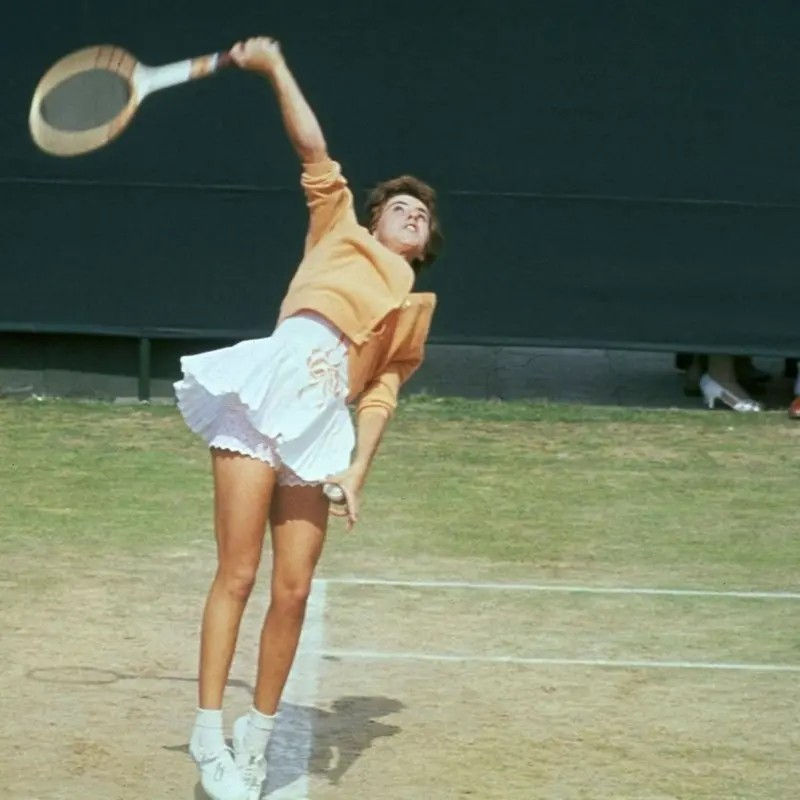
In 1962, Brazilian tennis player Maria Esther Bueno made waves at Wimbledon not just for her performance, but for her attire. While her white dress appeared to adhere to the All England Club's traditional dress code, it concealed a surprise: a pink lining and matching pink underpants. This revelation caused a significant commotion among spectators and officials, as recounted by tennis historian Sunita Kumar Nair in her book "Ace: The Times & Style of Tennis."
Bueno herself noted the collective gasp from one side of the court when she served, with onlookers on the other side only understanding the fuss when she switched sides. Following this incident, Bueno began wearing undergarments in Wimbledon's club colors of green and purple, which further irked the committee. This led Wimbledon to formalize its tradition of white attire into a strict rule, mandating that all competitors wear predominantly white clothing. Tennis historian Rob Lake suggests that the conservative All England Lawn Tennis and Croquet Club (AELTC) viewed Bueno's ruffled dress and visible undergarments as "tasteless and improper for a lady," reflecting the club's resistance to the social changes of the 1960s. At the time, the AELTC committee was composed entirely of men who sought to uphold the club's reputation and resisted social shifts.
The influence of designer Ted Tinling, who created Bueno's controversial outfit, was substantial in women's tennis fashion from the 1940s to the 1980s, with 75% of Wimbledon players wearing his designs. The tradition of white attire at Wimbledon dates back to 1877, initially a symbol of social status, as only the wealthy could afford to maintain white clothing. Over time, the adherence to white became a way for the tournament to assert its tradition within the sport. Previous controversies also involved American player Gussie Moran in 1949, whose lace-trimmed shorts were deemed vulgar, and French player Suzanne Lenglen in 1919, who challenged norms by abandoning corsets and long skirts. Even in 2014, Wimbledon's strictness continued, with Serena Williams and Roger Federer being cautioned for non-white accessories, underscoring the tournament's ongoing emphasis on its brand identity as "tennis in an English garden."
The 1962 Wimbledon incident involving Maria Esther Bueno's pink undergarments highlights the tension between evolving social norms and the preservation of institutional tradition. Wimbledon's strict dress code, rooted in historical notions of status and decorum, acted as a gatekeeper against the broader cultural shifts of the 1960s. The controversy underscores how sartorial choices can become symbolic battlegrounds for control over public image and adherence to established hierarchies. While ostensibly about maintaining a pristine aesthetic, the enforcement of the white dress code also reflects a paternalistic approach to female athletes' presentation, with male-dominated committees dictating acceptable appearances. Looking ahead, the increasing commercialization and branding of sporting events suggest that such dress codes may persist, driven by marketability and brand identity rather than purely aesthetic or historical considerations, potentially leading to future clashes between individual expression and corporate or institutional mandates.
AI-generated to prompt reflection — not editorial opinion, not advice, not a statement of fact. How this works.