Bumblebees' reactions suggest inner life, potentially emotions, study finds
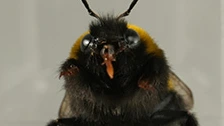
Bumblebees exhibit behaviors that suggest an inner life, potentially including emotions, according to a study by Australian and Chinese researchers. While mammals are known to express emotions, the question of whether insects do has long been debated since Darwin's era. This new research provides evidence that insects may indeed have subjective experiences. Researchers offered bumblebees various liquids, including water, sugar water, salt water, and bitter quinine water. Slow-motion footage revealed that after consuming water or sugar water, the bees extended their tongues contentedly. However, when offered salt water or quinine water, the bees shook their heads and appeared to wipe their mouths, a reaction described as similar to a rat's aversion to unpleasant tastes. This indicates that the bees' responses are not merely automatic chemical reactions but rather reflect a preference, suggesting they possess opinions about their environment and are more than just "reflex machines."
Further experiments demonstrated that the bees' reactions were influenced by their physiological state. For instance, when researchers simulated dehydration by warming the bees to 40 degrees Celsius, the insects readily consumed salt water, much like a thirsty runner would accept electrolyte drinks. This contrasts with their aversion to salt water when not dehydrated, proving the response is not an automatic reaction to specific chemical compounds. Lead researcher Andrew Barron stated that while he hesitates to use the term "emotions," the bees' reactions point to a "subjective psychological state." He emphasized that despite the tiny size of a bee's brain, the evidence suggests it possesses a form of mental life.
Colleague Fei Peng believes this research could alter public perception of insects, challenging the intuition that while insects may learn and make decisions, they cannot experience pleasure or displeasure. Barron noted the moral implications, suggesting that the lack of fundamental brain differences between insects like bees and flies necessitates a re-evaluation of how humans interact with and treat these creatures. The study highlights that there is still much to discover about insect cognition and experience.
This research challenges the anthropocentric view of consciousness by exploring subjective states in insects. The study's methodology, which differentiates between automatic chemical responses and state-dependent preferences, provides a robust framework for investigating insect cognition. By observing behavioral indicators like head-shaking and mouth-wiping in response to taste, the researchers propose a rudimentary form of 'liking' or 'disliking.' This perspective invites a broader consideration of sentience across species, prompting reflection on the ethical implications of human-insect interactions. As AI capabilities advance, understanding the spectrum of consciousness, from simple organisms to complex systems, will be crucial for developing ethical frameworks that acknowledge diverse forms of experience and intelligence.
AI-generated to prompt reflection — not editorial opinion, not advice, not a statement of fact. How this works.