BYD Unveils AI Team and Hybrid World Model for Autonomous Driving
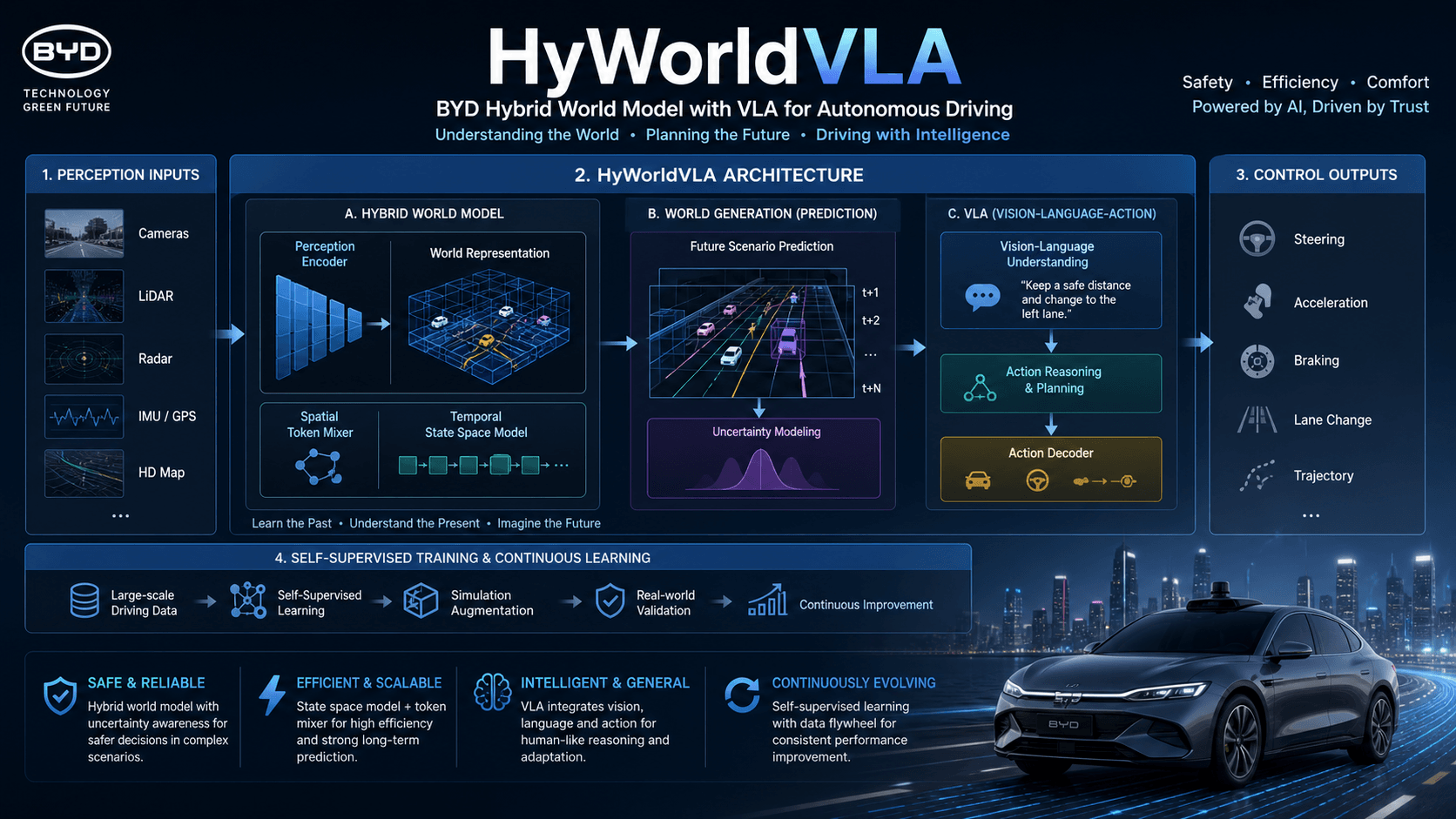
Chinese automaker BYD has revealed its AI team and introduced its HyWorldVLA model, marking a significant entry into the field of autonomous driving foundation models. The HyWorldVLA model utilizes a hybrid pixel-latent approach for world modeling, combined with a Vision-Language-Action (VLA) architecture. This innovative model achieved a state-of-the-art score of 90.59 PDMS on the NAVSIM benchmark, demonstrating its capabilities in understanding and navigating complex environments. The research team behind this development includes researchers from HIT Robotics, highlighting a collaboration between industry and academia. This achievement positions BYD as a notable player in the foundational AI research for autonomous driving systems. The company's focus on developing these advanced models underscores a strategic commitment to enhancing its self-driving technology.
BYD's public debut of its AI team and the HyWorldVLA model signals a strategic pivot towards foundational AI research in the competitive autonomous driving sector. By achieving a state-of-the-art benchmark score, BYD is demonstrating its commitment to developing robust, in-house capabilities rather than solely relying on external solutions. This move reflects a broader industry trend where automakers are increasingly investing in AI as a core competency. The hybrid pixel-latent world modeling approach suggests an effort to balance detailed environmental perception with efficient representation, a critical trade-off for real-time autonomous systems. Over the next decade, the success of such foundation models will be crucial for enabling scalable and reliable autonomous driving, potentially influencing regulatory frameworks and public trust in AI-driven transportation.
AI-generated to prompt reflection — not editorial opinion, not advice, not a statement of fact. How this works.