Call for Unity to Fulfill July Uprising Aspirations for a Democratic Bangladesh
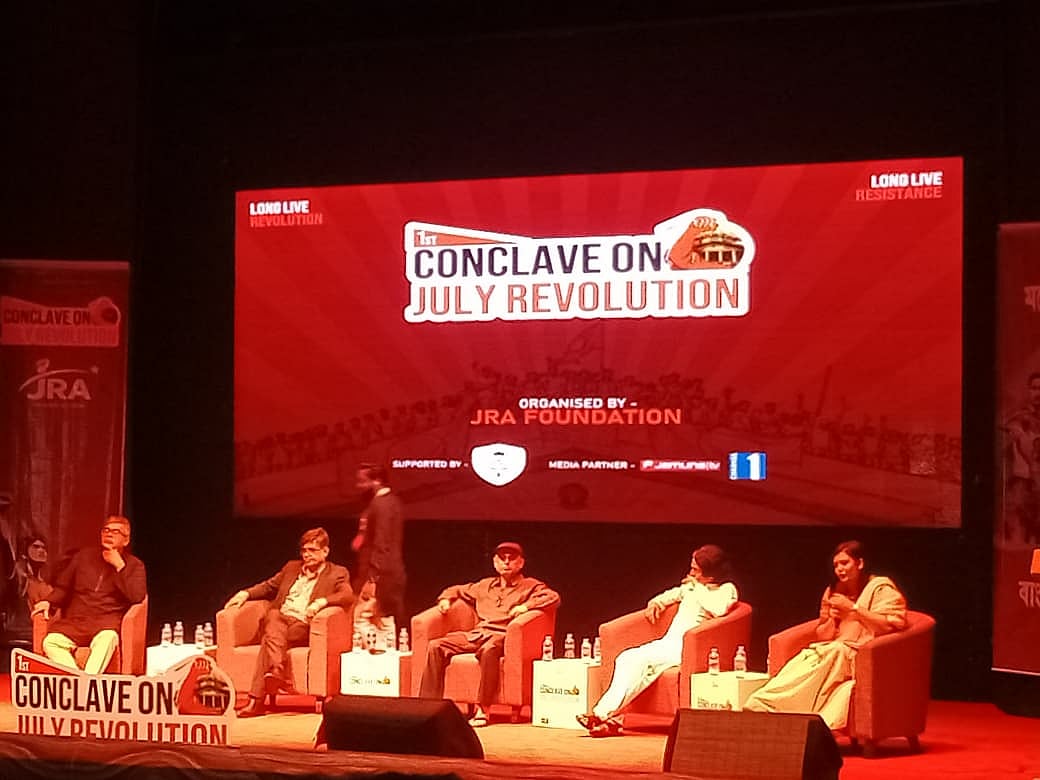
Prime Minister's Advisor and Office Spokesperson Mahadi Amin urged for national unity to build a discrimination-free, humane, and democratic Bangladesh, inspired by the spirit of the July mass uprising. He highlighted that participants in the July movement were united by their "pro-Bangladesh" identity, setting aside political differences to stand against fascism. The "First July Conclave on July Revolution" was organized by the July Revolutionary Alliance Foundation to commemorate the event. The event began with the national anthem, followed by Quran recitation and a moment of silence for the martyrs of the July uprising. Amin emphasized that while martyrs cannot be brought back, their dream of a Bangladesh with human rights, rule of law, freedom of expression, and equality can be realized. He acknowledged the ongoing pain of families who lost loved ones or are still recovering from injuries, assuring them of the government's and political leadership's sincere support. During Amin's speech, some attendees demanded a discussion on the July Charter, to which he responded that their suffering is understood and the movement's aspirations would be met through its implementation. He stressed the need to maintain the unity that led to the movement's success to advance nation-building efforts, promising to establish the rule of law and ensure justice for every killing.
National Citizen Party (NCP) Secretary and Member of Parliament Akhtar Hossain stated that a key aspiration of the July uprising was state reform and depoliticization, arguing that depoliticized institutions benefit everyone. He criticized attempts to portray the July events as a "planned conspiracy" as unrealistic, noting that the pre-uprising political climate left many feeling no path to escape authoritarian rule existed. Government Whip and MP ABM Ashraf Uddin Nizan called for the July spirit to be embodied through integrity and ethics, urging the new generation to protect democratic values. Reserved seat MP Sanjida Islam described the July movement as a popular expression of dignity, justice, and freedom led by students and youth, emphasizing the need for women's equal participation in building the new Bangladesh. Reserved seat MP Mardia Momtaz advocated for rebuilding state institutions on democratic foundations and promoting research on the history of the July uprising and liberation war. Former interim government advisor Mostafa Sarwar Farooqi criticized media and cultural figures who he claimed glorified a specific political force and marginalized dissent, stressing that the July uprising's promise of equal space for diverse views must be preserved. Former Press Secretary Shofiqul Alam alleged that individuals who opposed the uprising or supported authoritarianism still appear on television, accusing some media of past deception and continuing to provide platforms to the same people. Senior journalist Ashraf Kaysar countered attempts to frame the uprising as a "jihadist takeover," accusing some media and cultural figures of aiding the fascist regime and attempting to politically rehabilitate the Awami League. BDJobs CEO Fahim Mashroor described the July events as a "people's war" with significant casualties, criticizing media and intellectuals for siding with the ruling powers instead of the public and calling for a critical review of their roles.
The "First July Conclave on July Revolution" highlights a persistent societal tension between aspirations for democratic reform and the consolidation of political power. The event underscores the challenge of translating popular uprisings, fueled by a desire for justice and freedom, into lasting institutional change. Participants voiced concerns about the politicization of state institutions and media narratives, suggesting that the legacy of the July movement is contested. The discourse reveals a struggle to ensure accountability for past actions and to prevent the marginalization of dissenting voices, a critical dynamic in any society navigating transitions toward greater openness. The call for unity, while aspirational, faces the practical reality of entrenched political interests and differing interpretations of historical events, posing a significant hurdle for future governance and societal cohesion.
AI-generated to prompt reflection — not editorial opinion, not advice, not a statement of fact. How this works.