Cameroon Approves Ecosystem Restoration Project with Global Environment Facility Support
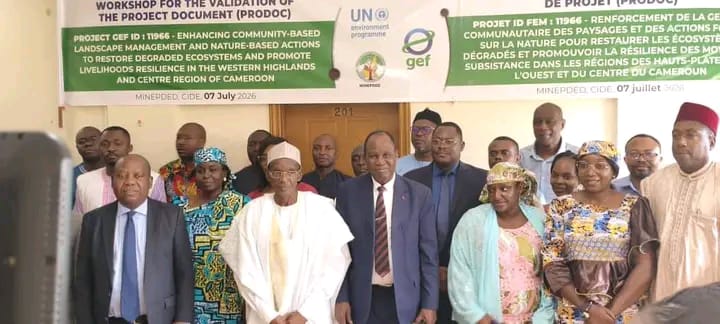
The Cameroonian government has advanced a significant ecosystem restoration initiative for the Western Highlands and the Mpem-Djim landscape. This project, backed by the Global Environment Facility (GEF), aims to harmonize biodiversity preservation, local development, and climate resilience. On July 7, 2026, in Yaoundé, the Minister of Environment, Nature Protection, and Sustainable Development, Hélé Pierre, led a workshop to validate the Project Document (ProDoc). This document outlines a program for strengthening community-based landscape management and restoring degraded ecosystems. The validation meeting included the Minister Delegate for Environment, a representative from the UN Environment Programme (UNEP) as the technical partner, and various sector administrations, experts, and civil society representatives. The GEF-approved project focuses on two critical areas: the Western Highlands, which has lost approximately 41% of its forest cover since 2002, and the Mpem-Djim landscape in the Centre region. Mpem-Djim is home to the eponymous national park, a sanctuary for iconic species like forest elephants and chimpanzees. The 36-month program plans to restore 10,000 hectares of degraded land, improve the management of nearly 100,000 hectares, and contribute to mitigating 5.7 million tons of CO2 equivalent over two decades. It is expected to directly benefit 5,000 individuals, including 2,500 women and over 500 indigenous community members. Beyond environmental goals, authorities are emphasizing enhanced landscape governance and the development of nature-based economic activities to embed natural resource protection within local development policies.
This initiative represents a strategic effort by Cameroon to address environmental degradation by integrating ecological restoration with socio-economic development. The project's reliance on GEF funding highlights the global recognition of the importance of these specific landscapes for biodiversity and climate mitigation. By focusing on community-based management and nature-based economic activities, the program seeks to create sustainable incentives for conservation, potentially shifting local economies away from practices that contribute to degradation. The inclusion of indigenous communities and women as direct beneficiaries suggests an awareness of equitable development principles. Looking ahead, the success of this 36-month project will likely depend on robust governance frameworks, effective monitoring of the 10,000 hectares targeted for restoration and the 100,000 hectares for improved management, and the long-term viability of the proposed nature-based economic models in the face of evolving climate and market dynamics.
AI-generated to prompt reflection — not editorial opinion, not advice, not a statement of fact. How this works.