Cameroon: Presidential Decrees Spark Controversy Over President Biya's Signature
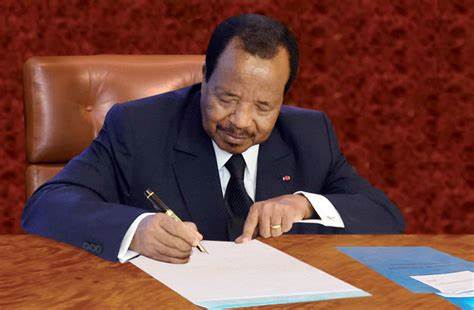
President Paul Biya of Cameroon has issued several decrees, but the authenticity of his signature on these documents has ignited a public debate. Internet users have pointed out apparent discrepancies between the signatures on recent decrees, dated July 22nd, and his previous ones, leading some to question their validity and suggest they might be imitations. A portion of the public believes the differing signatures could cast doubt on the credibility of the decrees. Others speculate that the president's health might be a factor, affecting his ability to sign consistently.
Beyond the signature controversy, the decrees themselves have drawn attention. Two appointments were made to the board of directors of the National Hydrocarbons Company, replacing deceased members. Additionally, decrees authorize the Minister of Economy to secure significant loans: one for €5.4 million and €857,132.55 from Deutsche Bank Spain for the Yaoundé Municipal Lake tourism project, and another for €33 million from the International Development Association (IDA) to fund the Adaptive Social Safety Nets and Economic Inclusion Project.
The timing and location of these decrees have also fueled criticism. Some netizens are questioning the practice of signing decrees impacting Cameroon while the president is reportedly in Switzerland, a move that exacerbates existing concerns about distant governance. Furthermore, the substantial new loans have raised alarms about Cameroon's growing national debt to international financial institutions.
The public's scrutiny of President Biya's signature on official decrees highlights a broader concern regarding transparency and accountability in governance. When official documents are perceived as potentially inauthentic or inconsistently signed, it can erode public trust in state institutions. The financial aspects of the decrees, involving significant international loans, underscore the ongoing challenge of managing national debt and ensuring that borrowed funds are effectively utilized for development projects. The debate over 'distant governance' also points to systemic questions about leadership presence and decision-making processes in the digital age, particularly when leaders are abroad. Future governance models may need to incorporate more robust digital verification mechanisms and clearer communication strategies to maintain public confidence and ensure effective national administration.
AI-generated to prompt reflection — not editorial opinion, not advice, not a statement of fact. How this works.