CERN's Large Hadron Collider to Undergo Major Upgrade, Restarting in 2030
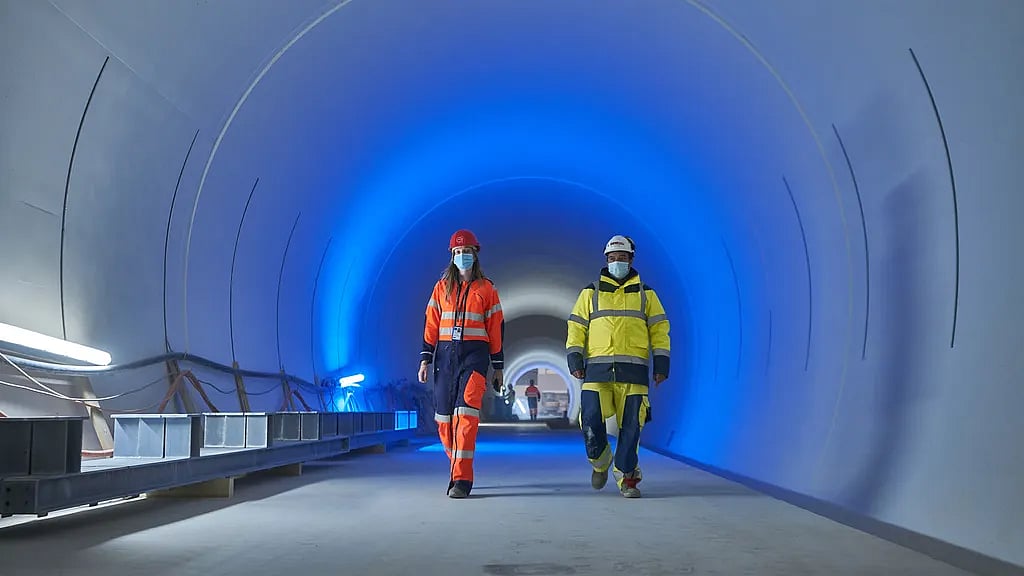
The Large Hadron Collider (LHC), the world's largest and most powerful particle accelerator, has been temporarily shut down for a four-year upgrade. This shutdown, which began on June 29th, is not due to malfunction but is a planned measure to enhance the machine's capabilities. The upgraded facility, to be renamed the High-Luminosity Large Hadron Collider (HL-LHC), is scheduled to recommence operations in 2030. This modernization aims to increase the collider's particle collision rate by approximately tenfold compared to its original design. Scientists anticipate that this enhanced capability will facilitate groundbreaking discoveries in fundamental physics, offering deeper insights into dark matter, antimatter, and the early universe. The HL-LHC is expected to operate until 2040, after which it will be replaced by a new, higher-energy accelerator. This marks the third major planned shutdown in the LHC's history, following previous upgrades in 2013 and a period from 2018 to 2022. The current 'Long Shutdown 3' involves replacing about 1.2 kilometers of old magnets and equipment with advanced technology to boost luminosity. During this period, researchers will continue analyzing data from previous experiments. The LHC, located near Geneva on the Franco-Swiss border, has been instrumental in particle physics research since its first successful proton collision in 2009, notably contributing to the discovery of the Higgs boson in 2012.
The planned upgrade of the Large Hadron Collider signifies a strategic investment in pushing the boundaries of fundamental physics research. By enhancing luminosity and collision rates, CERN aims to gather significantly more data, potentially resolving current limitations in the Standard Model, such as the nature of dark matter and dark energy. This long-term vision for scientific exploration, extending beyond 2040, reflects a commitment to sustained inquiry into the universe's most profound mysteries. The technological advancements developed for the HL-LHC may also yield unforeseen applications in other fields, mirroring past innovations from CERN. This upgrade period also highlights the complex engineering and management required for such large-scale scientific endeavors, emphasizing the collaborative nature of modern research.
AI-generated to prompt reflection — not editorial opinion, not advice, not a statement of fact. How this works.