China and Pakistan Urge US and Iran to Resume Talks Amid Escalating Hostilities
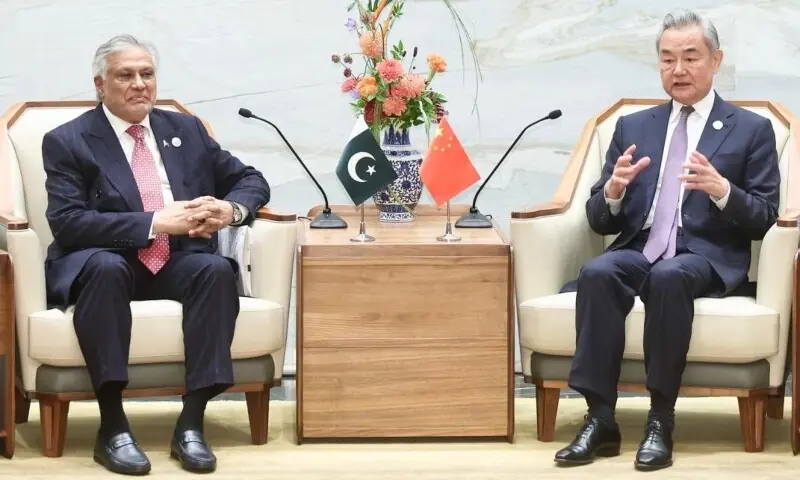
China and Pakistan have jointly called for the United States and Iran to cease hostilities and return to negotiations, following a meeting between Chinese Foreign Minister Wang Yi and Pakistani Deputy Prime Minister and Foreign Minister Ishaq Dar in Shanghai on Friday. Both ministers expressed deep concern over the escalating Middle East conflict, which has seen renewed fighting around the Strait of Hormuz after a preliminary peace deal signed in June. Wang Yi emphasized the importance of not losing the progress made towards peace, stating that the agreement was "hard-won" and that peace was within reach. Deputy Prime Minister Dar was in Shanghai to attend the World Artificial Intelligence Conference. The meeting also covered bilateral relations between Pakistan and China, with both sides expressing satisfaction with their "all-weather strategic cooperative partnership" and reaffirming their commitment to deepening it. They agreed to enhance cooperation in areas such as trade, investment, science and technology, the digital economy, and artificial intelligence, particularly focusing on advancing high-quality development under the China-Pakistan Economic Corridor (CPEC) 2.0. The discussions also included regional and global developments, with both nations pledging to maintain close coordination and cooperation in multilateral forums. This call for de-escalation comes as Iran reported launching new attacks on US facilities in the Gulf, following several nights of US strikes on Iranian military sites, jeopardizing the truce established in June. Pakistan, acting as a mediator, has urged all parties to exercise restraint to prevent further undermining of regional peace and stability.
The joint appeal by China and Pakistan highlights their strategic interest in regional stability, particularly concerning energy transit routes like the Strait of Hormuz. Their mediation efforts, alongside discussions on economic cooperation like CPEC 2.0 and AI development, suggest a broader agenda of expanding influence and fostering economic ties in a volatile geopolitical landscape. The call for de-escalation reflects a desire to prevent conflicts that could disrupt trade and investment flows, while also positioning themselves as neutral arbiters. This approach allows them to engage with multiple parties without direct entanglement, potentially enhancing their diplomatic standing and economic opportunities in the long term. The emphasis on technological cooperation, including AI, indicates a forward-looking strategy to build partnerships based on future economic drivers.
AI-generated to prompt reflection — not editorial opinion, not advice, not a statement of fact. How this works.