China Develops Nuclear Battery Capable of Powering Devices for Millennia
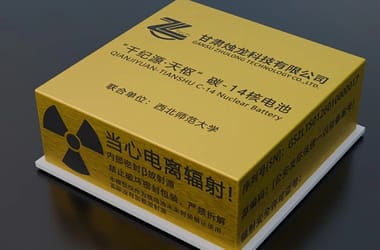
China has developed a novel nuclear battery designed for industrial applications, representing a significant advancement over existing technologies. This entirely domestically engineered power source is capable of providing electricity for thousands of years. The battery utilizes a radioactive isotope to generate power, offering a long-lasting and potentially revolutionary energy solution. While specific details regarding the isotope used and the exact energy output are not provided, the technology is positioned as a superior alternative to current battery systems. Its development signifies China's growing capabilities in advanced energy technologies and its ambition to lead in industrial innovation. The potential applications are vast, ranging from powering remote sensors and medical devices to potentially even larger-scale energy needs over extremely extended periods. This breakthrough could redefine energy storage and power generation for long-term, low-maintenance requirements.
China's development of a nuclear battery capable of powering devices for millennia highlights a strategic push towards long-duration, low-maintenance energy solutions. Such technology, if scalable and safe, could address critical infrastructure needs in remote or inaccessible environments, reducing reliance on conventional power grids and frequent battery replacements. The underlying principles of radioisotope thermoelectric generators (RTGs) have existed for decades, but advancements in material science and miniaturization may enable new applications. The economic and environmental implications, particularly concerning the sourcing and disposal of radioactive materials, warrant careful consideration. Future developments will likely focus on safety, cost-effectiveness, and regulatory frameworks to integrate this potentially transformative energy source into industrial and potentially consumer markets.
AI-generated to prompt reflection — not editorial opinion, not advice, not a statement of fact. How this works.