China's Auto Export Surge Drives First Real New Car Price Drop in Brazil in Six Years
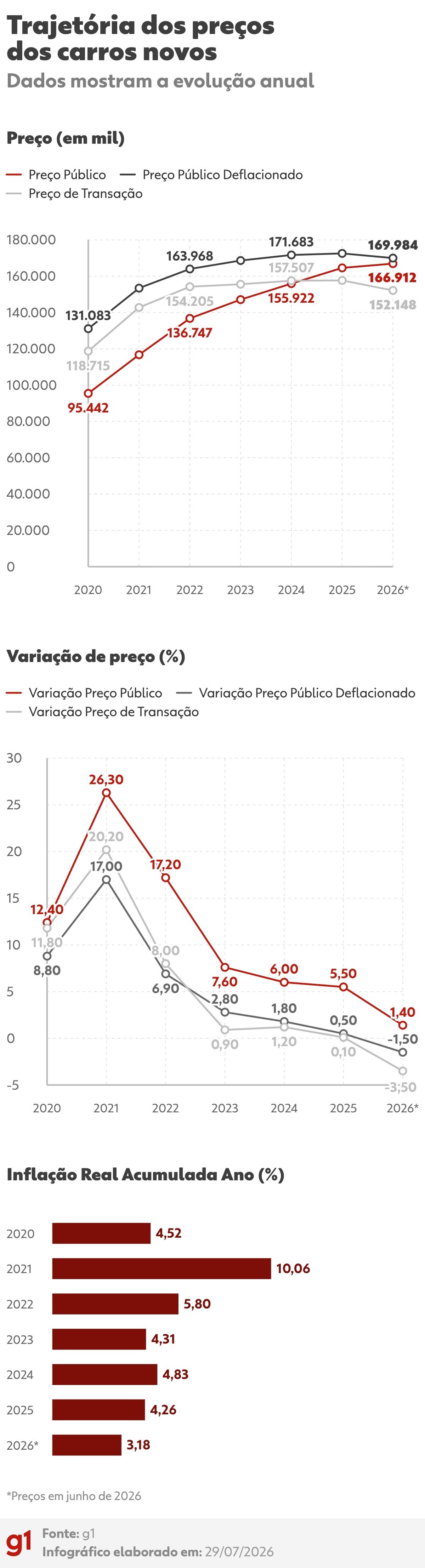
For the first time in six years, the average price of new cars in Brazil has experienced a real decrease, falling 1.5% below inflation in 2026. While the nominal average price rose 1.4% to R$166.9 thousand, this increase was outpaced by the official inflation rate of 3.18%. This marks a significant slowdown from the previous year's 5.5% increase. The primary driver behind this price deceleration is the aggressive expansion of Chinese automakers into the Brazilian market, intensifying competition and compelling traditional manufacturers to accept lower profit margins. However, stagnant incomes and high vehicle financing interest rates continue to make purchasing a new car unaffordable for a large segment of the population. The actual transaction price, after negotiation, saw a more substantial drop of 3.5% in 2026, from R$157.6 thousand to R$152.1 thousand. This difference, facilitated by factory bonuses, enhanced trade-in values for used cars, and targeted financing rate cuts, reflects dealers' efforts to clear accumulated inventory. Chinese manufacturers, benefiting from massive production scales in their home market—estimated at 34 million vehicles annually—are prioritizing international profitability due to a saturated domestic market. BYD, for instance, produced approximately 4 million cars in 2025. This strategy has positioned Brazil as the leading importer of Chinese vehicles in the first half of 2026, with imports totaling $5.2 billion, $4.5 billion of which were electric and hybrid models. These companies have also vertically integrated their production, manufacturing key components like batteries internally, which reduces costs and enhances quality. Despite the lower average prices, high annual interest rates on vehicle financing, ranging from 18% to 22%, and the current base interest rate of 14.25% (Selic) continue to hinder sales, as approximately 60% of car purchases in Brazil typically rely on financing.
The influx of Chinese automotive manufacturers into Brazil, driven by their immense production scale and strategic pricing, has demonstrably altered the domestic market dynamics, leading to a rare real price decrease for new vehicles. This competitive pressure on legacy automakers highlights the evolving global automotive landscape, where production volume and supply chain control are increasingly critical for market penetration. While lower prices offer potential consumer benefits, the persistent challenge of high financing costs, linked to Brazil's macroeconomic interest rate environment, suggests that accessibility remains a significant barrier. Future market trajectory will likely depend on the interplay between continued price competition, potential shifts in consumer credit availability, and the sustained technological advancements offered by new entrants, all within the context of global trade policies and domestic economic conditions.
AI-generated to prompt reflection — not editorial opinion, not advice, not a statement of fact. How this works.