China's Renewable Energy Investment Hits Record High Amidst Geopolitical Tensions
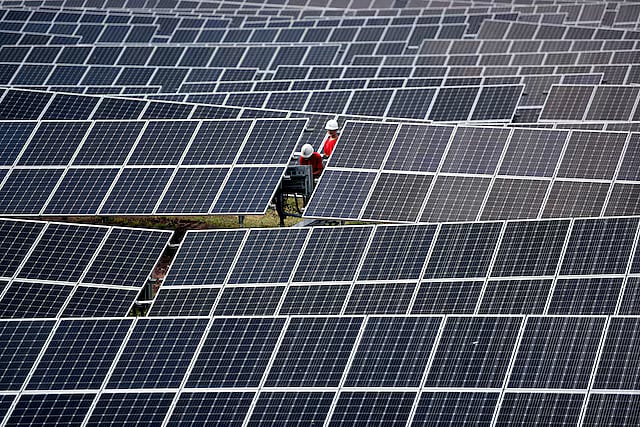
China's investment in environmentally friendly energy sectors reached a record high of $20.1 billion in the first half of 2026, driven by increased global demand for cheaper renewable energy sources. This surge is partly attributed to the geopolitical instability stemming from the US-Iran conflict, which has led to price volatility in traditional energy markets. Research from the University of Queensland and the Green Finance and Development Center indicates that the value of green energy projects under China's Belt and Road Initiative (BRI) in the first half of 2026 surpassed the entire year of 2025. Of this total, $11.8 billion was allocated to construction projects and $8.3 billion to investments.
Christoph Nedopil Wang, an expert in Chinese energy and finance at the University of Queensland, noted that China's investment in green energy continues despite trade wars due to its cost-effectiveness. Countries collaborating with China on these projects may benefit from reduced energy price fluctuations caused by the Iran conflict. Overall BRI contract values also saw a record increase to $126.3 billion in the first half of 2026, up from $123.3 billion in the same period the previous year. Significant funding also flowed into manufacturing, technology, metals, and mineral sectors.
Analysts suggest that the rise in oil and gas prices following tensions involving Iran, coupled with increased demand for power and data center infrastructure due to AI expansion, has accelerated Chinese investment in BRI's energy and related sectors. Concurrently, China's official customs data reveals substantial growth in exports of green technology products. The BRI, launched by President Xi Jinping in 2013, is a key tool for Beijing to expand its economic influence and trade relations in developing nations. Recent data also highlights a significant shift in BRI, with private sector participation rising to 48% in the first half of 2026, a stark increase from 13% in 2022, indicating a move towards commercially driven investment decisions rather than solely state directives. Despite ongoing criticisms regarding debt burdens and opaque contract terms in BRI projects, investment in Africa has tripled to $33.5 billion in the first half of 2026, though new projects have not been announced in Pakistan and Russia, suggesting a potential slowdown in those regions.
The surge in Chinese investment in renewable energy under the Belt and Road Initiative, particularly in the context of geopolitical instability and rising energy prices, highlights a strategic alignment of economic incentives with global energy transition trends. The increasing role of private sector actors in BRI projects suggests a maturation of the initiative, shifting towards commercially viable opportunities and potentially enhancing the global competitiveness of China's green technology sector. However, this expansion must be viewed against the persistent concerns regarding debt sustainability and transparency in developing economies, which could create systemic risks. As the world navigates the dual challenges of energy security and climate change, the BRI's evolving dynamics present a complex interplay of economic opportunity, geopolitical influence, and developmental impact, demanding careful assessment of long-term implications for partner nations and the global financial system.
AI-generated to prompt reflection — not editorial opinion, not advice, not a statement of fact. How this works.