China's Submarine-Launched ICBM Test Sparks Regional Alarm
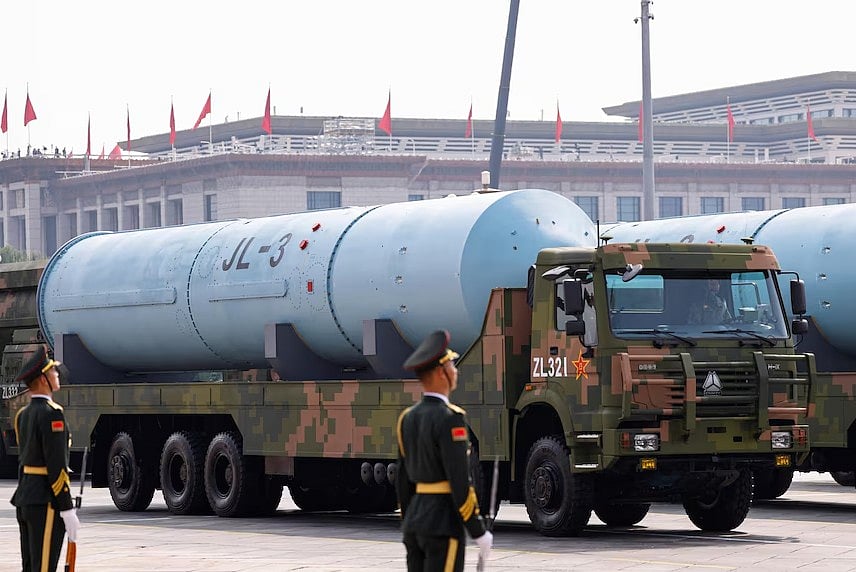
China conducted a test of an intercontinental ballistic missile (ICBM) launched from a nuclear-powered submarine in the Pacific Ocean on Monday, drawing criticism from the United States, Japan, Australia, and New Zealand. These nations view the action as a demonstration of Beijing's expansionist stance. China's Ministry of National Defense stated the missile was launched at 12:01 PM local time from a submarine and traveled thousands of kilometers, carrying no warhead. According to China's state news agency Xinhua, the launch was part of annual military drills and not aimed at any specific country. This marks China's first ICBM test from a submarine in the Pacific in nearly two years. Chinese Foreign Ministry spokesperson Mao Ning asserted the test was conducted safely and professionally. Australia, Japan, and other nations complained they were notified only hours before the launch, a point Mao Ning hoped would not be exaggerated. The U.S. Department of Defense confirmed monitoring the launch, which landed in the southern Pacific, noting it was a long-range missile capable of striking the U.S. mainland from China's coastal waters. The missile, possibly a JL-2 or the more advanced JL-3, has a range of at least 7,300 kilometers, potentially reaching its maximum range if it was a JL-2. The U.S. State Department criticized China's actions as undermining international arms control efforts, especially as the U.S. prioritizes non-proliferation. Australia's Prime Minister Anthony Albanese called the test a "provocative act" destabilizing the region and expressed concern over the short notice and the nature of the weapon. New Zealand's Foreign Minister Winston Peters deemed the test "unwelcome and concerning," suggesting it violated a treaty establishing the South Pacific as a nuclear-weapon-free zone. Taiwan viewed the test as an attempt to intimidate the international community, while the Prime Minister of the Solomon Islands, a friend of China, stated such tests are not beneficial for the region and urged against intimidation. Experts suggest the timing, coinciding with an Australia-Fiji defense pact, may signal a response to U.S. and allied influence in the Indo-Pacific, though the notification timing is also noteworthy. The test provides insights into the People's Liberation Army's capabilities and could potentially damage China's image in the South Pacific.
This ICBM test by China from a submarine in the Pacific represents a significant escalation in regional military posturing. While China frames it as routine training, the timing and location—within a declared nuclear-weapon-free zone and shortly before an Australia-Fiji defense pact signing—suggest a deliberate signal to the U.S. and its allies. The test highlights the inherent tension between China's growing military power and its stated commitments to regional stability and arms control. The international response underscores concerns about transparency and the potential for miscalculation in a complex geopolitical landscape. Future strategic assessments will likely focus on the technological advancements demonstrated and their implications for deterrence and the balance of power in the Indo-Pacific, particularly in the context of evolving AI-driven warfare capabilities.
AI-generated to prompt reflection — not editorial opinion, not advice, not a statement of fact. How this works.