China's Zhongke Tianta Launches Smart Production Line for Satellite Laser Communication Terminals
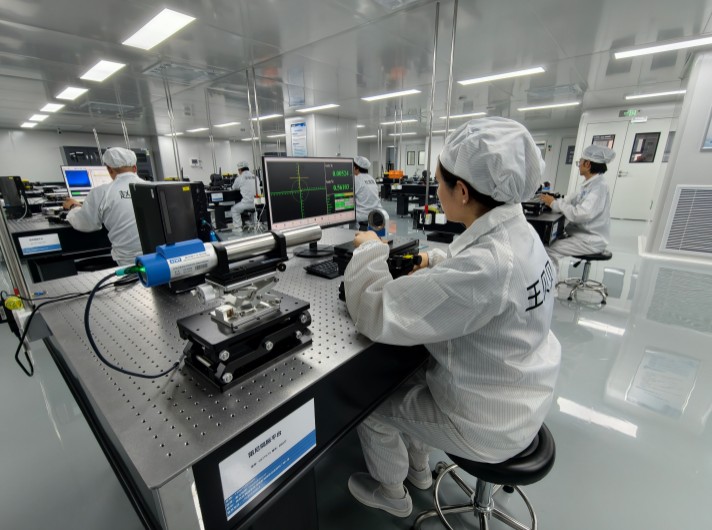
Zhongke Tianta has officially launched its smart production line for space-based laser communication terminals in Xi'an, China, on July 16th. This development is crucial as the rapid expansion of low-Earth orbit satellite constellations increases the demand for data transmission between satellites. Laser communication offers significant advantages over traditional microwave communication, including higher bandwidth, lower latency, and enhanced resistance to interference, making it a key technology for large-scale satellite internet infrastructure.
The initial phase of the production line is designed to produce 600 sets annually, with plans to exceed 1,000 sets per year by 2027. The 2,000-square-meter facility incorporates advanced processes from component assembly and integration to precision debugging, space environment simulation, and automated testing. It is equipped with a digital management system and an automated testing platform capable of simultaneously testing multiple devices and monitoring product status.
The mass-produced laser communication terminals will support data rates from 5Gbps to 100Gbps and are designed to be compact, power-efficient, and robust, suitable for various low-Earth orbit satellite constellations. The technology stems from over two decades of research by the Chinese Academy of Sciences' Xi'an Institute of Optics and Precision Mechanics (XIOPM). Zhongke Tianta is also developing an AI model named "Huashan" for satellite operations, which will integrate with the laser communication terminals to assist in tasks like collision risk assessment and fault identification, aiming to reduce reliance on ground-based human operations.
The establishment of this smart production line signifies a strategic advancement in China's satellite internet capabilities, addressing the growing need for high-volume, high-performance inter-satellite communication. By leveraging advanced manufacturing and AI, the initiative aims to enhance operational efficiency and reduce costs in space-based data networks. This move positions China to play a more significant role in the global satellite communications landscape, potentially influencing market dynamics and technological standards in the coming decade. The integration of AI with hardware infrastructure suggests a forward-looking approach to managing complex satellite constellations, enabling more autonomous and responsive space operations.
AI-generated to prompt reflection — not editorial opinion, not advice, not a statement of fact. How this works.