China Successfully Tests Net-Based Rocket Booster Recovery System
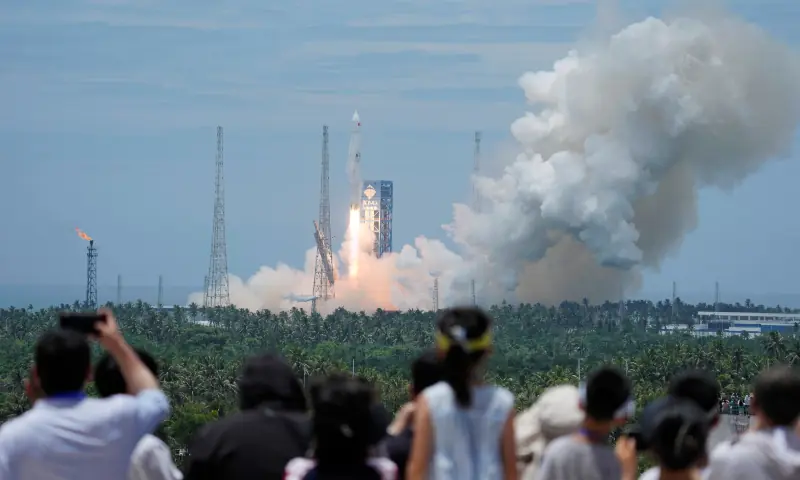
China conducted a successful test of an experimental rocket retrieval system on Friday, utilizing a net attached to a sea platform to recover a booster. The Long March 10B rocket launched from the Hainan commercial space launch site at 12:15 PM local time. Approximately six minutes after booster and upper stage separation, the booster vertically returned and was successfully recovered on an offshore platform, as reported by state broadcaster CCTV. This marks China's first successful recovery of an orbital-class rocket booster, advancing its efforts to develop reusable rocket technology and challenge US dominance in this sector. The rocket also successfully delivered a satellite into its designated orbit. Shares in Chinese aerospace companies, including China Spacesat and China Satellite Communications, saw significant gains, reaching their daily trading limits following the news. The Long March 10B, developed by the China Academy of Launch Vehicle Technology (CALT), is designed for commercial aerospace and can carry at least 16 metric tons to low-Earth orbit. Unlike SpaceX's Falcon 9, which uses deployable legs for autonomous landings, the Long March 10B employs four "landing hooks" to capture the booster in the net. CALT experts suggest this net-based recovery simplifies onboard structures, reduces mass, increases payload capacity, and offers adaptability to landing deviations. China has invested nearly a decade in reusable rocket technology, with this test representing a significant step toward lowering launch costs for its expanding commercial satellite constellations. The country aims to reuse the Long March 10B's booster stage for another launch by the end of this year.
This successful test of a net-based rocket booster recovery system by China signifies a strategic advancement in its space capabilities, particularly in the pursuit of reusable launch vehicles. By adopting a net-capture method, China appears to be optimizing for payload capacity and structural simplicity, potentially offering a different engineering pathway compared to the autonomous landing systems favored by SpaceX and Blue Origin. This development highlights the intensifying global competition in commercial spaceflight, where cost reduction through reusability is a key driver for expanding satellite constellations and future space exploration. The focus on reusable technology aligns with broader national ambitions, including lunar missions, and suggests a long-term strategy to reduce dependence on foreign launch capabilities and establish a more self-sufficient space economy. The success could also stimulate further investment and innovation within China's burgeoning private space sector.
AI-generated to prompt reflection — not editorial opinion, not advice, not a statement of fact. How this works.