China Successfully Tests Sea-Based Rocket Booster Recovery System
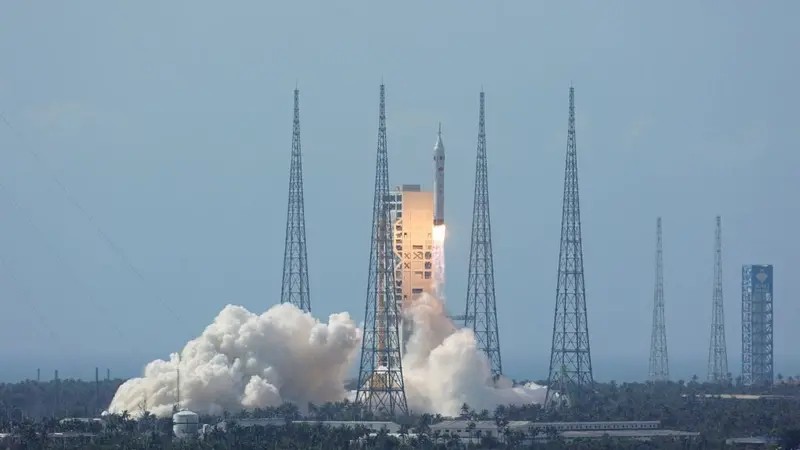
China has successfully conducted a test of an experimental sea-based rocket booster recovery system, marking a significant step towards developing reusable rockets and challenging the United States' dominance in this field. The Long March 10B rocket launched from the Hainan commercial space launch center at 12:15 PM local time on Friday, May 10th. Approximately six minutes after the booster and upper stage separated, the booster returned vertically and was successfully recovered using a net deployed from a maritime platform. This achievement represents China's first successful recovery of an orbital-class rocket booster, bringing the nation closer to reusable rocket technology. Following the news, shares of Chinese aerospace companies like China Spacesat and China Satellite Communications saw significant gains, reaching their daily upper limits. The Long March 10B, developed by the China Academy of Launch Vehicle Technology, is designed to carry at least 16 metric tons to low Earth orbit and has been compared to SpaceX's Falcon 9. However, unlike the Falcon 9's autonomous landing on legs, the Long March 10B utilizes a net capture system. SpaceX achieved its first orbital rocket landing in December 2015, with Blue Origin's New Glenn following in November 2025. SpaceX's Falcon 9 currently performs around 150 launches annually, with boosters reused multiple times. The recovery of the booster, which houses the engine, is considered crucial for cost reduction. China has invested nearly a decade in reusable rocket technology, progressing from low-altitude hover tests to recent orbital recovery attempts. This advancement is expected to lower launch costs for China's rapidly expanding commercial satellite constellations. The Long March 10B is part of the Long March 10 family, intended for China's crewed lunar missions before 2030, and this test may provide valuable data for that program. China plans to reuse the Long March 10 booster stage for another launch by the end of the year.
This successful test of a sea-based recovery system for orbital-class rocket boosters signifies China's strategic advancement in reusable launch vehicle technology. By employing a net-capture method, China is exploring an alternative to the autonomous leg-landing systems pioneered by U.S. companies like SpaceX and Blue Origin. This approach could offer different operational efficiencies and potentially reduce the complexity and cost associated with booster recovery, which is critical for enabling large-scale commercial satellite constellations and future space exploration missions, including lunar endeavors. The development aligns with global trends toward cost-effective space access and highlights the intensifying international competition in the burgeoning commercial space sector. Future success will depend on the reliability and cost-effectiveness of this recovery method over repeated cycles and its integration into a robust launch cadence, potentially influencing the economic viability of China's ambitious space programs over the next decade.
AI-generated to prompt reflection — not editorial opinion, not advice, not a statement of fact. How this works.