China Unicom and Huawei Launch World's Largest 5G-A 100Mbps Uplink Network in Beijing
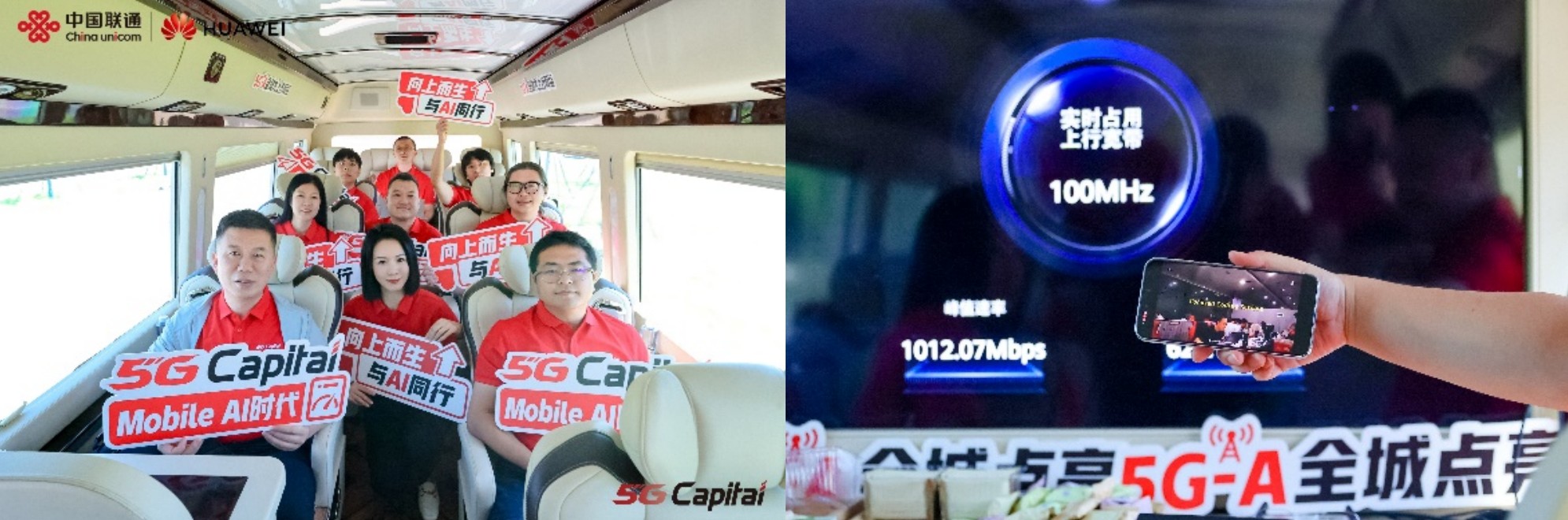
China Unicom's Beijing branch, in collaboration with Huawei, has launched the world's largest commercial 5G-Advanced (5G-A) network featuring 100Mbps uplink speeds. This innovative network provides continuous 100Mbps uplink coverage across key areas of Beijing, utilizing over 10,000 base stations. Third-party media outlets conducted on-site tests, confirming the network's robust coverage and stable user experience, with an 83% uplink 100MHz effective ratio and only 0.1% of tests experiencing poor uplink speeds below 20Mbps. This achievement marks a significant advancement for China Unicom's network in Beijing, moving from city-wide 5G-A deployment to comprehensive large uplink capabilities.
During the tests along a 34-kilometer route, the network, supported by a 3.5GHz + 2.1GHz coordinated network, demonstrated impressive uplink performance. Key metrics included an 83% uplink 100MHz effective ratio, a peak uplink speed of 1Gbps, an average uplink speed of 397Mbps, and 72% of tests achieving excellent uplink speeds above 300Mbps. These results effectively support demanding mobile AI applications, such as real-time data backhaul from AI glasses and cameras for analysis, seamless interaction with AI agents on smartphones, and instant uploads of captured content. Miao Shouye, Deputy General Manager of China Unicom Beijing, highlighted that the accelerating integration of AI into daily life necessitates networks that are not only fast for downloads but also stable and accurate for uploads, crucial for the Mobile AI era. Li Jie, President of Huawei Wireless TDD Product Line, expressed pride in supporting China Unicom's leading network position with Huawei's innovative solutions, emphasizing continued technological advancements to build a user-experience-centric 5G-A network.
The deployment of a large-scale 5G-A network with enhanced uplink capabilities addresses the evolving demands of the Mobile AI era, where data generation and real-time processing are increasingly critical. This infrastructure development signifies a strategic shift from passive content consumption to active data creation and interaction, driven by new AI-powered devices and applications. The focus on uplink speed and stability suggests a recognition of the network's role in enabling distributed intelligence and real-world data capture. Future network evolution will likely prioritize further integration of AI into network management and optimization, alongside continued efforts to balance uplink and downlink performance across diverse user scenarios and emerging technologies like low-altitude applications.
AI-generated to prompt reflection — not editorial opinion, not advice, not a statement of fact. How this works.