Chinese Academy of Sciences Unveils Reasoning Lens to Visualize AI Model Thought Processes
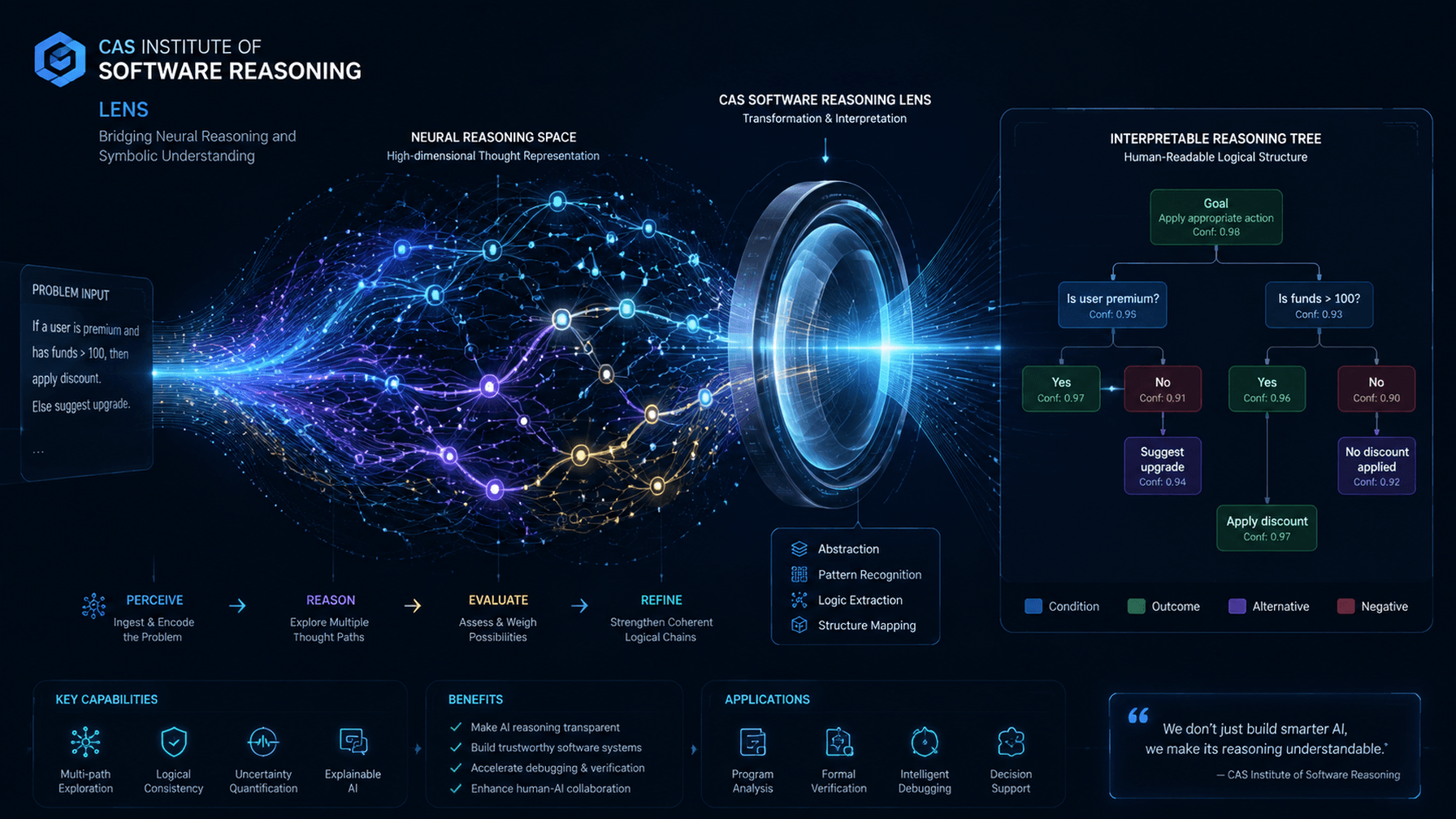
Researchers at the Chinese Academy of Sciences (CAS) have developed a new system called Reasoning Lens. This innovative tool is designed to address the growing challenge of transparency in large artificial intelligence models. Reasoning Lens aims to make the internal thinking processes of AI models visible and understandable. It allows users to visualize and diagnose the reasoning chains that AI models follow when making decisions or generating outputs. This capability is crucial for understanding how complex AI systems arrive at their conclusions. The development by the CAS Institute of Software is a significant step towards demystifying the 'black box' nature of advanced AI. By providing insights into AI reasoning, the system can help identify potential biases or errors in model logic. This enhanced transparency is expected to improve the reliability and trustworthiness of AI applications across various fields. The tool's diagnostic features will aid developers in debugging and refining AI models more effectively.
The introduction of Reasoning Lens by the CAS Institute of Software highlights a critical industry-wide challenge: the interpretability of complex AI models. As AI systems become more sophisticated, understanding their decision-making pathways is essential for accountability, debugging, and building trust. This development could foster a more rigorous approach to AI governance, enabling researchers and developers to scrutinize model behavior more effectively. The ability to visualize reasoning chains may also reveal emergent properties or unintended consequences within AI architectures, prompting further investigation into model robustness and ethical alignment. Over the next decade, as AI integration deepens, tools like Reasoning Lens will likely become indispensable for ensuring AI systems operate reliably and align with human values, moving beyond mere performance metrics to a deeper understanding of AI cognition.
AI-generated to prompt reflection — not editorial opinion, not advice, not a statement of fact. How this works.