Chinese Researchers Create Indium-Free Molecular Bridge for Advanced Solar Cells
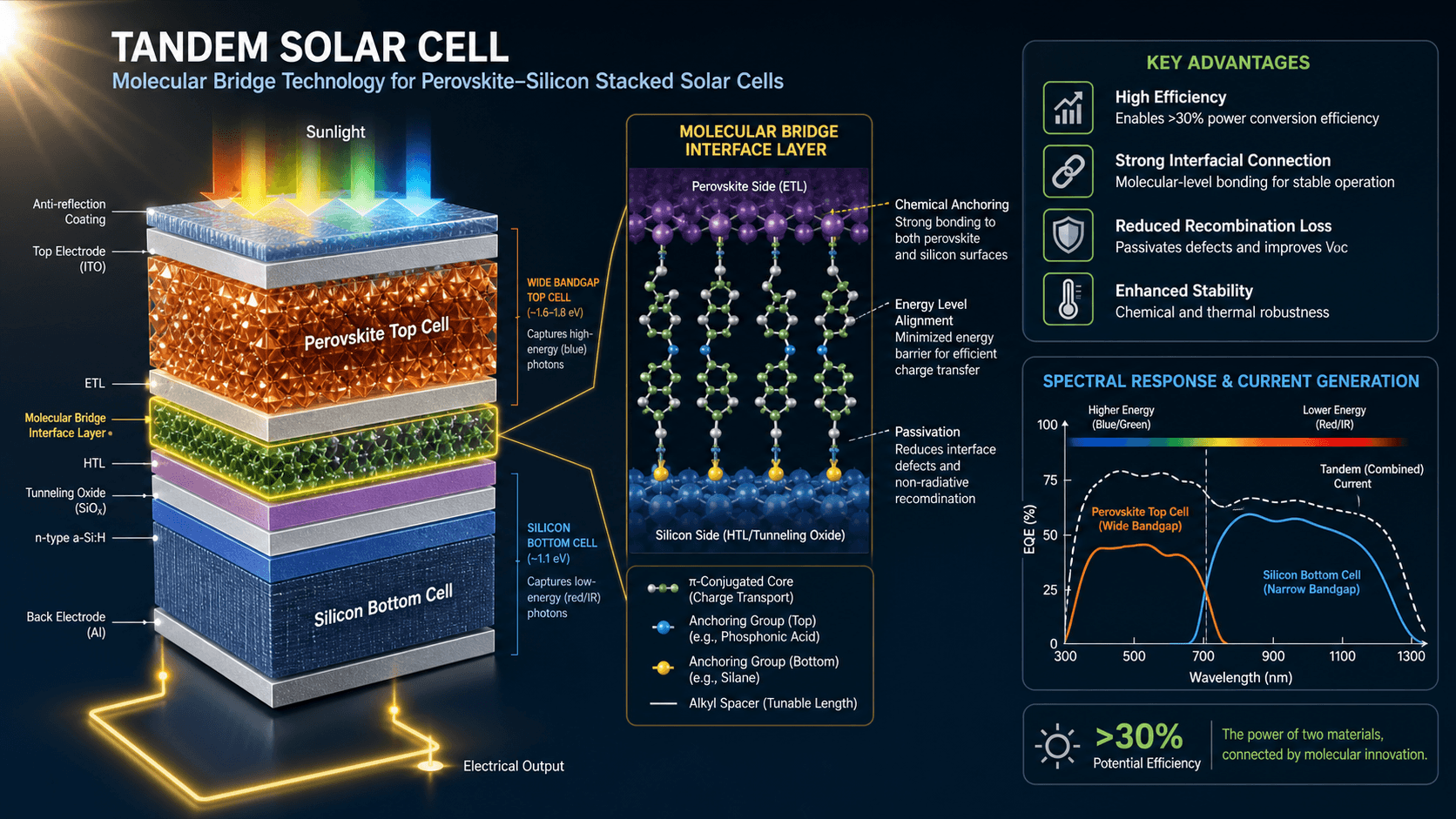
A joint research team from Soochow University and Hong Kong Poly has developed an innovative indium-free composite layer for tandem solar cells. This new layer utilizes a 'molecular bridge' to connect the perovskite and silicon components of the cell. The primary goal of this development is to significantly improve both the efficiency and the long-term stability of these next-generation photovoltaic devices. Traditional tandem solar cells often rely on materials like indium, which can be costly and have supply chain concerns. By creating an indium-free alternative, the researchers aim to make advanced solar technology more sustainable and economically viable. The molecular bridge is designed to facilitate better charge transfer between the perovskite and silicon layers, a critical factor in boosting overall energy conversion rates. Furthermore, this structural enhancement is expected to mitigate degradation issues that have previously limited the operational lifespan of similar solar cells. This breakthrough could pave the way for more powerful and durable solar panels in the future.
The development of an indium-free composite layer for tandem solar cells addresses critical material sourcing and cost challenges in renewable energy. By employing a molecular bridge to enhance charge transfer and stability between perovskite and silicon, researchers are targeting a key bottleneck in photovoltaic performance. This approach could reduce reliance on rare or expensive elements, potentially lowering manufacturing costs and improving the scalability of high-efficiency solar technologies. Future advancements may focus on optimizing the molecular bridge's structure for even greater efficiency gains and ensuring its long-term resilience under diverse environmental conditions. The success of such indium-free designs will be a significant indicator of the industry's progress towards more sustainable and accessible solar power generation within the next decade.
AI-generated to prompt reflection — not editorial opinion, not advice, not a statement of fact. How this works.