Cockroach 'diving suits' could aid future rescue missions, researchers say
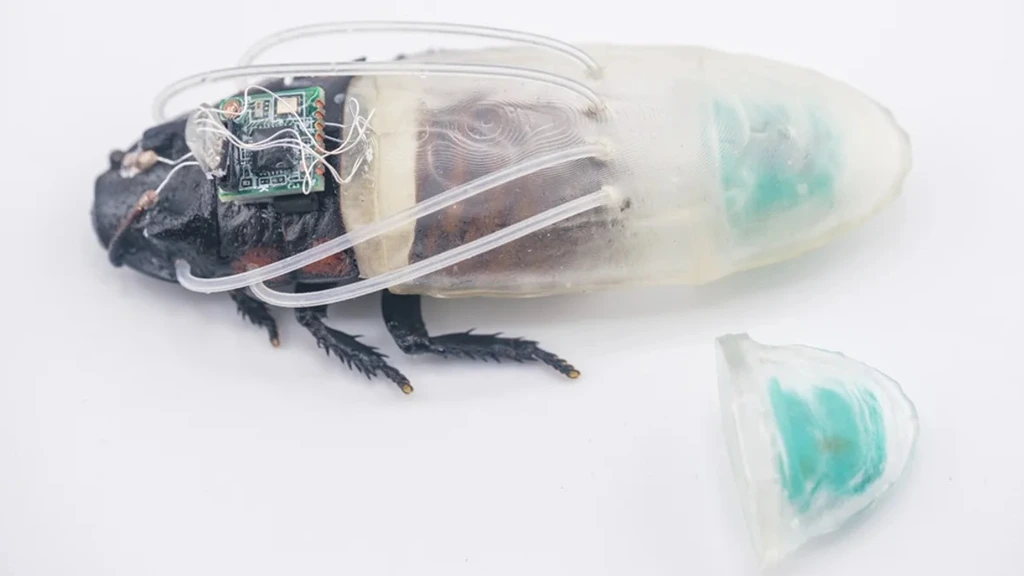
Researchers from technical universities in Singapore and Japan have developed a 'diving suit' for cockroaches, potentially enabling them to assist in search and rescue operations, particularly after floods. This specialized suit, equipped with an oxygen tank, allows the insects to survive underwater for up to three hours. The team utilized the Madagascar hissing cockroach, a species that grows to several centimeters and can carry up to 15 grams. The current suit weighs 5.5 grams, leaving room for future enhancements like sensors or navigation systems. These 'amphibious cyborg-insects,' as the scientists term them, can be remotely controlled. Their compact design and low energy consumption allow them to navigate confined and cluttered spaces both on land and underwater. Cockroaches breathe through openings on their thorax, and the suit's oxygen generator supplies air via small tubes. This builds upon previous research from 2022, where Japanese scientists developed a remote control system for cockroaches using electrical signals to locate survivors after events like earthquakes. However, the current technology is not yet deployable due to challenges in precise control. The development raises ethical questions regarding animal welfare, specifically whether the cockroaches experience pain from the electrodes or the backpack. While the researchers ensured the insects had clean living conditions and received weekly food, it remains unclear if they suffered discomfort from the suit. A 2022 scientific study suggests that insects like cockroaches are likely capable of experiencing pain.
The development of 'cyborg-insects' for search and rescue operations presents a novel approach to leveraging biological capabilities with technological augmentation. While the potential utility in disaster scenarios is evident, the ethical implications surrounding animal welfare must be rigorously addressed. Future iterations will need to balance operational effectiveness with a demonstrable commitment to minimizing any potential distress to the insects, potentially through advanced non-invasive control mechanisms or alternative species. The long-term viability of such systems will depend not only on technological refinement but also on public and scientific acceptance of human-insect collaboration in critical rescue efforts, considering the evolving understanding of insect sentience and pain perception.
AI-generated to prompt reflection — not editorial opinion, not advice, not a statement of fact. How this works.