Comet's Unusual Spin Reversal Hints at Potential Self-Destruction
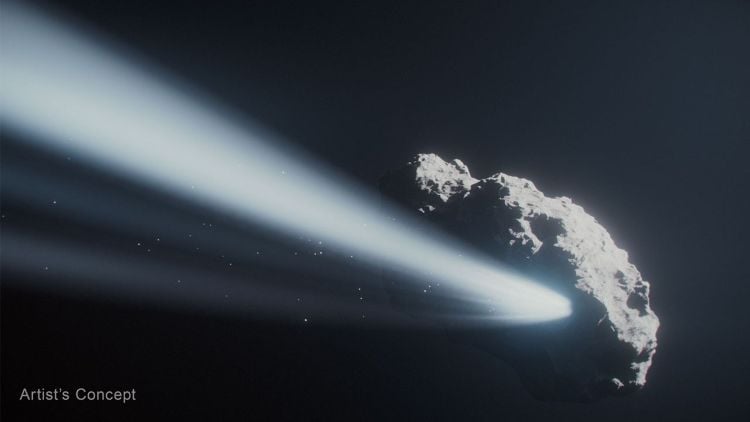
Comets are celestial bodies primarily composed of ice, typically orbiting far from the Sun. When they approach the Sun, their icy cores heat up and evaporate, creating the characteristic long, luminous tails that are often observed. While these tails provide spectacular visual displays, scientists are more interested in these icy remnants as they offer insights into the origins of our solar system, estimated to be around 4.6 billion years old. Recent observations of a particular comet have revealed an unusual phenomenon: a reversal in its spin. This unexpected behavior has led scientists to speculate that the comet might be heading towards self-destruction. The evaporation process, while visually stunning, fundamentally alters the comet's structure and dynamics. The observed spin reversal could be a direct consequence of these changes, potentially indicating an unstable state.
The observed spin reversal in a comet, potentially leading to its self-destruction, highlights the dynamic and often volatile nature of these ancient solar system remnants. As comets approach the Sun, the phase transition of their icy components into gas creates significant outgassing, which can exert forces on the comet's nucleus. This outgassing process, while essential for the formation of a visible tail and enabling scientific observation, can also lead to rotational instability. The phenomenon underscores the complex interplay between solar radiation, sublimation, and rotational dynamics in cometary evolution. Understanding such events provides valuable data for refining models of cometary behavior and offers a glimpse into the processes that shaped the early solar system, while also illustrating the inherent fragility of these celestial bodies in the face of solar proximity.
AI-generated to prompt reflection — not editorial opinion, not advice, not a statement of fact. How this works.