Deadly 100 km/h Winds Cause Deaths, Blackouts, and Destruction in Brazil
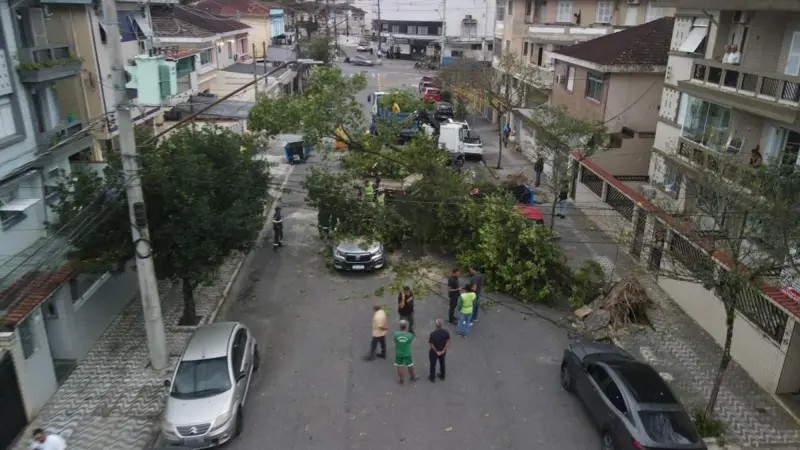
Strong wind gusts exceeding 100 km/h swept through Brazil's South and Southeast regions on Wednesday, July 29th, leaving a trail of fatalities, destruction, and widespread power outages. In São Paulo state, three people died, including a 62-year-old man in Cesário Lange whose car was crushed by a falling tree and another individual in Santos who was struck by a tree. A third death occurred in São Sebastião, where a fishing boat capsized. The state's Civil Defense issued severe alerts for the capital and greater São Paulo due to risks of falling trees and roof damage, impacting operations at Congonhas and Guarulhos airports. Wind speeds in São Paulo reached a peak of 124.9 km/h in Itaporanga. In Rio de Janeiro, two people died when a wall collapsed in Santa Teresa, and a fisherman is missing in Mambucaba. The capital experienced winds around 100 km/h, with gusts of 105 km/h recorded at Galeão airport. The wind temporarily closed the Rio-Niterói Bridge and suspended flights at Santos Dumont Airport, also causing power outages and affecting train and subway services. The intense winds were attributed by Climatempo to a cold front's passage, exacerbated by a sharp thermal contrast between hot, dry air and the incoming cold, humid air. Temperatures in Rio had reached 35.8°C, and 35.2°C in Santos, prior to the front's arrival. Meanwhile, on Tuesday, July 28th, the state of Rio Grande do Sul experienced a tornado in its northwest region, causing injuries to four people, widespread damage to dozens of homes, power outages, and blocked roads, with wind speeds potentially reaching 300 km/h. This tornado was linked to a supercell storm, a phenomenon capable of producing severe hail, intense winds, and tornadoes.
The extreme weather events in Brazil, including the high-speed winds and tornado, highlight the vulnerability of urban and coastal infrastructure to rapid atmospheric shifts. The meteorological explanation points to significant thermal contrasts driving wind acceleration, a phenomenon likely to be amplified by climate change trends that can increase temperature extremes. This necessitates a proactive approach to urban planning and infrastructure resilience, focusing on early warning systems and robust building codes. The events also underscore the importance of coordinated crisis management between state and local authorities, as well as energy providers, to mitigate the cascading effects of such natural disasters on essential services and public safety. Future preparedness will require integrating advanced meteorological forecasting with adaptive infrastructure strategies to manage increasing weather volatility.
AI-generated to prompt reflection — not editorial opinion, not advice, not a statement of fact. How this works.