Dephasingless Electron Acceleration Achieved with Flying Focus Laser Wakefield Technique
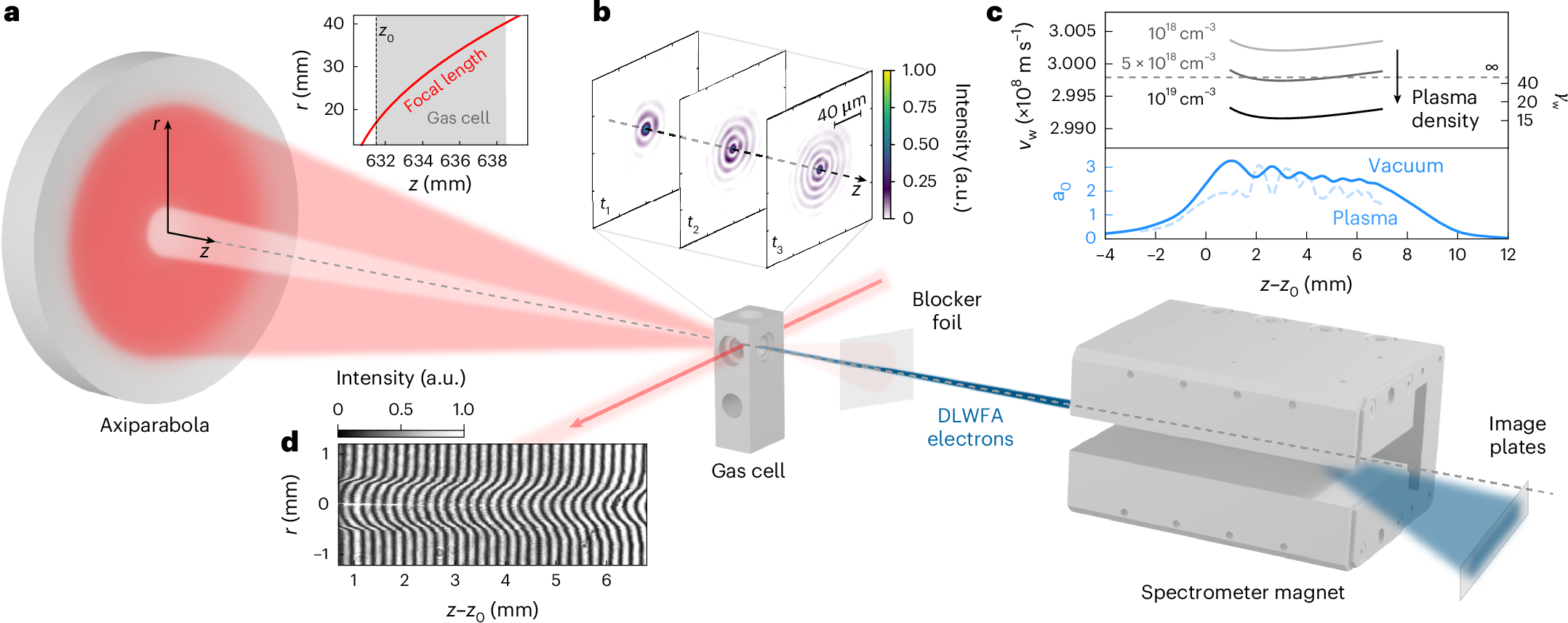
Researchers have demonstrated a novel method for accelerating electrons using a dephasingless laser wakefield technique combined with a flying focus. This advanced approach overcomes a key limitation in traditional laser wakefield acceleration (LWFA), which is the dephasing between the accelerating electron bunch and the plasma wave. The flying focus technology allows the focal point of the laser pulse to move along the propagation direction, effectively keeping the electron bunch within the accelerating phase of the plasma wave for a longer duration. This sustained interaction enables more efficient energy transfer from the laser to the electrons. The experiment successfully accelerated electrons to high energies with improved quality, paving the way for more compact and powerful particle accelerators. This breakthrough has significant implications for various fields, including fundamental physics research, medical imaging, and cancer therapy, where high-energy electron beams are crucial. The dephasingless LWFA with a flying focus represents a significant step forward in harnessing laser-plasma interactions for advanced acceleration technologies.
The development of dephasingless laser wakefield acceleration using a flying focus addresses a critical bottleneck in laser-driven particle acceleration, potentially leading to more compact and efficient accelerators. By maintaining the electron bunch within the optimal accelerating phase, this technique enhances energy gain and beam quality. This advancement could democratize access to high-energy particle beams, fostering innovation in scientific research, medical applications like radiotherapy and diagnostics, and industrial processes. Future research will likely focus on scaling this technology to higher energies and repetition rates, while also managing the complex laser-plasma dynamics and engineering challenges associated with flying focus systems. The long-term impact hinges on the ability to translate these laboratory successes into robust, cost-effective, and widely deployable accelerator systems.
AI-generated to prompt reflection — not editorial opinion, not advice, not a statement of fact. How this works.