Deputy Home Affairs Minister Bima Arya Stresses Leadership Sustainability
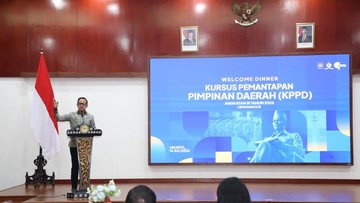
Deputy Home Affairs Minister Bima Arya has emphasized the critical importance of sustainability in leadership for the advancement of development. He urged stakeholders to move beyond sectoral egoism to foster collective progress. Arya highlighted that a sustainable approach to leadership is essential for long-term development goals. This involves ensuring that policies and initiatives are designed to endure and yield benefits over time, rather than focusing on short-term gains. The minister's call to abandon sectoral interests signifies a push towards greater inter-agency cooperation and a unified vision for national progress. By working collaboratively and prioritizing the common good over individual departmental agendas, it is believed that more effective and impactful development outcomes can be achieved. This perspective underscores the need for a paradigm shift in how leadership is exercised, moving towards a more integrated and forward-looking model.
The statement by Deputy Home Affairs Minister Bima Arya highlights a common governance challenge: the tension between short-term, often politically motivated, sectoral interests and the long-term strategic needs of national development. The emphasis on 'sustainability in leadership' suggests a recognition that effective governance requires continuity of policy and vision, transcending individual tenures or departmental priorities. This perspective aligns with a growing global understanding of complex systems, where integrated approaches are more resilient and effective than fragmented ones. The call to 'leave sectoral egoism' points to the systemic friction caused by siloed bureaucratic structures. Addressing this requires institutional reforms that incentivize cross-sectoral collaboration and align individual and departmental goals with overarching national objectives, particularly in the context of accelerating technological and societal changes over the next decade.
AI-generated to prompt reflection — not editorial opinion, not advice, not a statement of fact. How this works.