Dhaka Metro Rail Staff Suspend Protest Until August 7 Over Service Rules
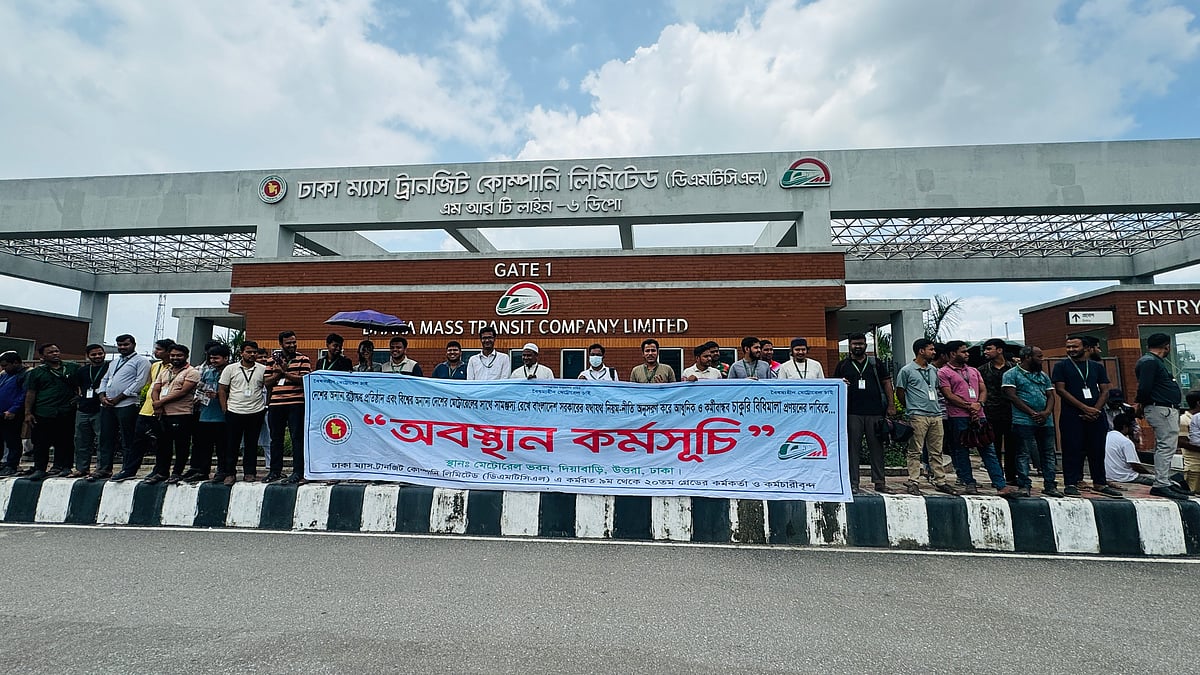
Regular officers and employees of Dhaka Mass Transit Company Limited (DMTCL) have suspended their ongoing sit-in protest demanding the implementation of independent service rules until August 7. The employees, who have been protesting since Friday at the Metro Rail Bhaban in Diabari, decided to temporarily halt their demonstrations for the sake of passenger service. However, they have warned of more stringent actions if the service rules are not enacted by the deadline. The protest, which ran from 9 AM to 1:20 PM on Friday, follows similar demonstrations held from 9 AM to 5 PM on July 28, 29, and 30, during which train services remained normal. The metro rail workers claim that despite DMTCL's establishment over a decade ago in 2013, no distinct service rules have been formulated for its more than 900 regular employees. They have been working day and night since the metro rail commenced operations on December 28, 2022. The absence of service rules has created uncertainty, discrimination, and a lack of transparency regarding job security, disciplinary procedures, promotions, transfers, and administrative decisions, leading to growing discontent and impacting the organization's operations. Although an advisor directed the formulation of service rules within 60 working days by September 12, 2024, it has not been implemented. Following employee demands, the DMTCL board approved the service rules in its 73rd meeting, but they were sent for review by the Ministry of Finance and the Ministry of Public Administration. Seven months later, there has been no visible progress. The workers had hoped for a decision on enacting the service rules during the July 30 board meeting, but its postponement led to their decision to suspend the protest until August 7. They reiterated their threat of more severe actions if the rules are not implemented, holding DMTCL authorities responsible for any public inconvenience. An anonymous DMTCL official cited difficulties in integrating a project due to a High Court ruling as a primary reason for the delay, suggesting a group is obstructing the process for personal gain. This official also alleged that the lack of service rules has led to arbitrary personnel placements, harassment of dissenting officials, and changes to experience requirements for recruitment.
The suspension of the protest by DMTCL employees highlights a systemic governance challenge in implementing essential administrative frameworks for public service infrastructure. The delay in enacting service rules, despite directives and board approvals, suggests potential bureaucratic inertia or conflicting interests within or between government bodies. This situation creates operational inefficiencies and employee dissatisfaction, potentially impacting service quality and long-term institutional stability. Moving forward, establishing clear accountability mechanisms and transparent processes for rule formulation and implementation will be crucial for ensuring the smooth functioning of critical public services like the metro rail. The situation also underscores the need for robust legal and administrative structures that can adapt to the rapid expansion of public infrastructure projects in the face of evolving operational needs and regulatory landscapes.
AI-generated to prompt reflection — not editorial opinion, not advice, not a statement of fact. How this works.