Dragonfly Aerial Combat Mimics Fighter Pilot Agility
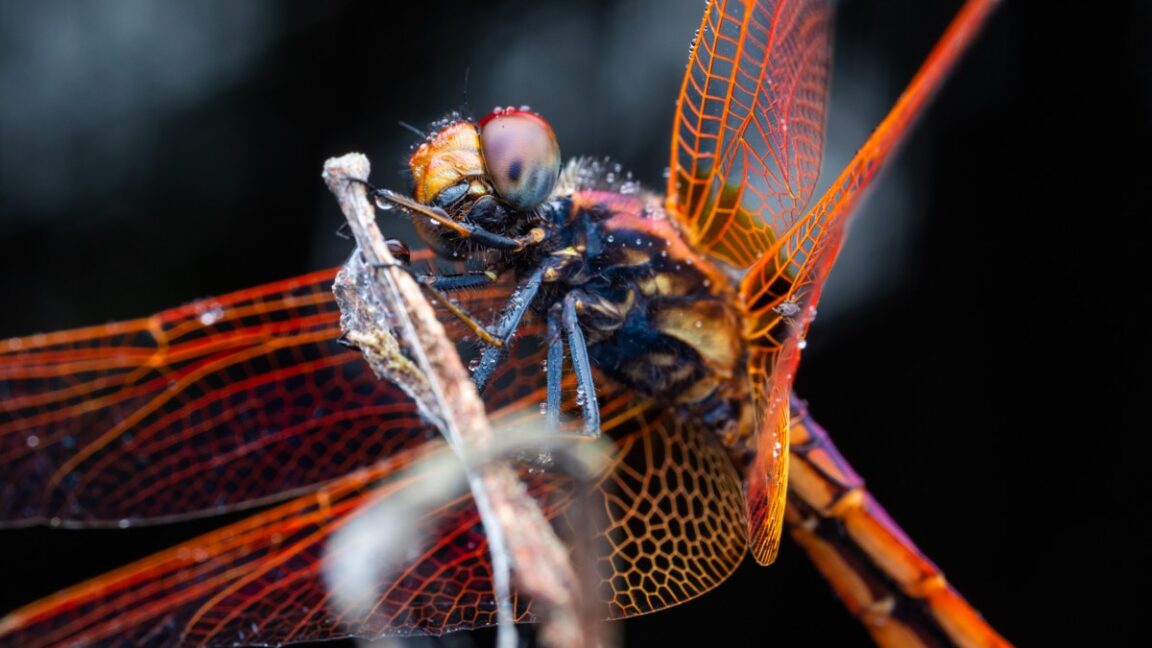
New research reveals that male dragonflies' impressive aerial combat maneuvers are surprisingly derived from simple vision-based rules. These insects engage in dramatic displays of agility, reminiscent of fighter pilots navigating complex airspace. The study suggests that their sophisticated flight patterns are not the result of complex internal calculations but rather a direct response to visual cues encountered during flight. This finding offers a fascinating glimpse into the biological mechanisms underlying insect flight and predatory behavior. Understanding these rules could have implications for the design of autonomous aerial vehicles. The research highlights how evolution has equipped dragonflies with efficient strategies for survival and competition. Their ability to perform such complex maneuvers from basic visual input is a testament to the power of natural selection. This work provides a foundation for future studies on insect neurobiology and biomechanics.
This research offers a compelling case study in how complex emergent behaviors can arise from simple underlying rules, a principle applicable across biological and artificial systems. The dragonfly's vision-based navigation, mirroring sophisticated aerial combat, suggests that efficient biological algorithms can be far more parsimonious than previously assumed. This insight could inform the development of more agile and responsive autonomous systems, particularly in drone technology, by focusing on reactive sensory processing rather than purely predictive models. The study prompts consideration of how similar principles might be leveraged in other fields, from robotics to traffic management, to achieve high performance with reduced computational overhead and increased adaptability in dynamic environments.
AI-generated to prompt reflection — not editorial opinion, not advice, not a statement of fact. How this works.