Dutch USAR team returns from Venezuela after failing to rescue survivors
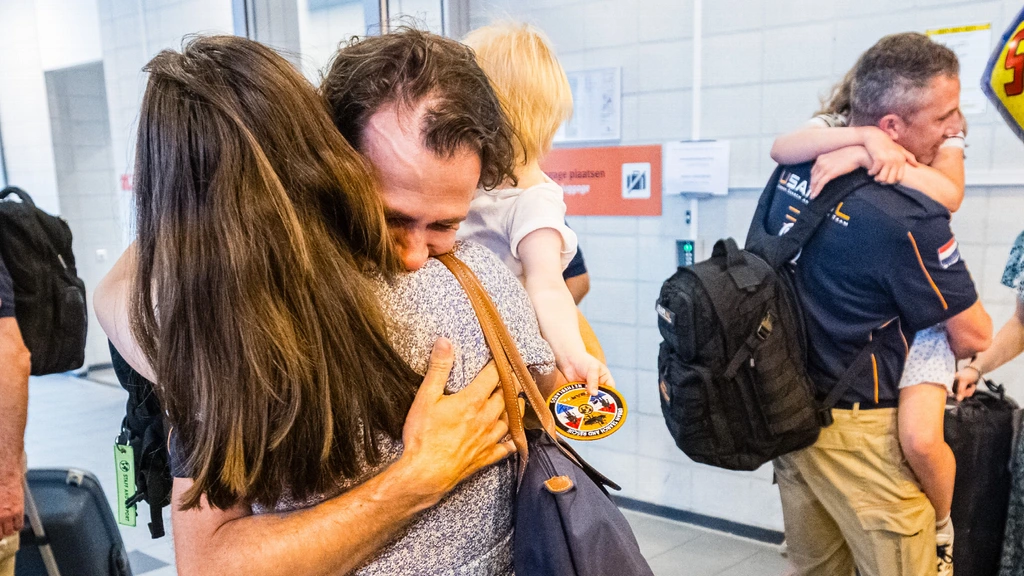
The Dutch USAR (United States Agency for International Development) search and rescue team has returned to Eindhoven Air Base in the Netherlands after a deployment to Venezuela. The team of 64 members and eight search dogs arrived home to a welcome from loved ones. Team member Hans Hoogstrate described the scale of the disaster as deeply impressive and the working environment as hectic, challenging due to the extensive destruction and high temperatures. The team was deployed the day after Venezuela was struck by two earthquakes measuring 7.2 and 7.5 magnitude. After a week, the likelihood of finding survivors significantly decreases, prompting the team's decision to depart. Despite their efforts, the USAR team was unable to rescue any survivors from the rubble. Hoogstrate expressed disappointment, stating that their primary goal is to save lives, but acknowledged that their presence was in areas where no survivors remained. Marcel Huijbrechts, another team member, noted that even in Nepal, where he had previously assisted, survivors were found later in the rescue operation, despite a larger international presence. Erik Geskus highlighted the extreme heat and humidity, along with the immense difficulty of penetrating collapsed fourteen-story buildings with thick concrete slabs. While unable to save lives, the team provided a crucial service by confirming that no one was alive in collapsed structures, offering closure to grieving families. Huijbrechts observed that this clarity allowed relatives to begin their grieving process and arrange for the recovery and burial of their loved ones. The international support also bolstered the morale of the Venezuelan population, demonstrating that the global community had not forgotten them. The team felt they offered hope, comfort, and perspective amidst profound sorrow. The official death toll from the earthquakes stands at 2,295, but UN estimates suggest tens of thousands of fatalities, with a missing persons list containing 36,000 names. Huijbrechts acknowledged the immense scale of the tragedy, citing the collapse of three apartment buildings that housed thousands of people. He expressed gratitude for returning home safely to his own loved ones.
The Dutch USAR team's mission in Venezuela highlights the complex realities of international disaster response. While the primary objective of saving lives was not met, the team's secondary role in providing closure and confirming fatalities underscores the multifaceted nature of humanitarian aid. The immense scale of the Venezuelan earthquakes, with potential death tolls in the tens of thousands, presents significant challenges for any rescue operation, particularly given the advanced stage of the disaster when international teams arrived. This situation raises systemic questions about pre-positioning of resources, international coordination protocols, and the psychological toll on rescue workers who face profound loss. The team's experience also points to the importance of managing expectations for both the affected population and the international community, balancing the immediate need for hope with the stark realities of survival probabilities in such catastrophic events.
AI-generated to prompt reflection — not editorial opinion, not advice, not a statement of fact. How this works.