Earth's True Shape Revealed: Not a Sphere, But an Irregular 3D Model
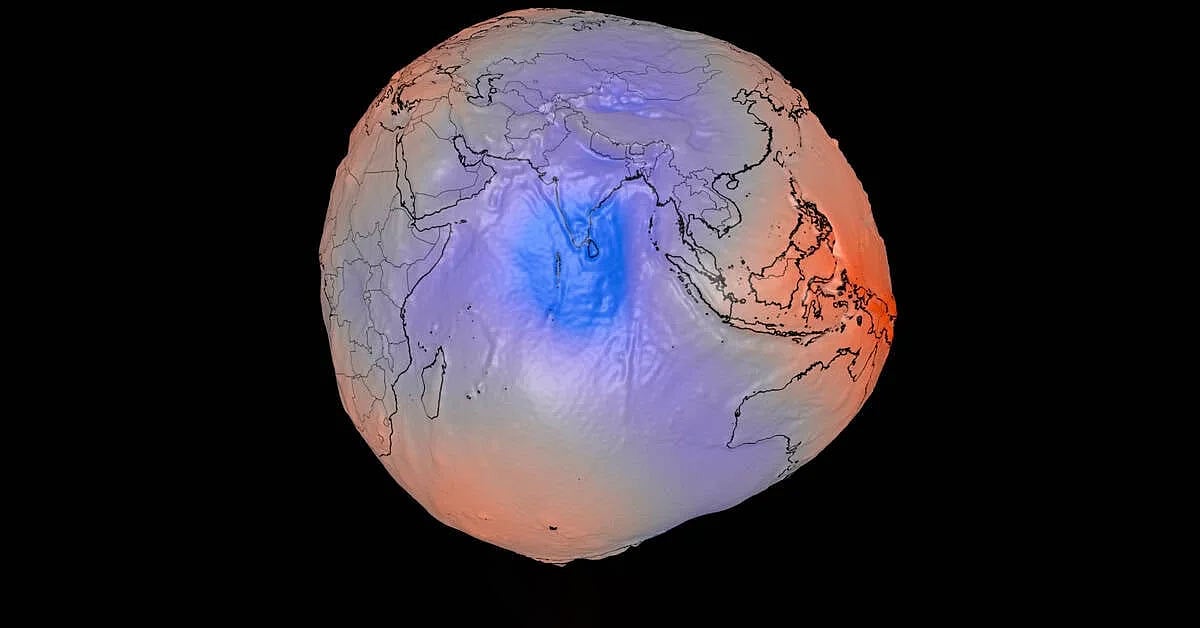
Scientists have created a precise 3D model of Earth by calculating its gravitational forces. This model reveals that our planet is not perfectly spherical or smooth. Instead, its shape is quite irregular, resembling a bumpy potato. The findings challenge the common perception of Earth as a simple sphere. The new model offers a more accurate representation based on gravitational data. This detailed visualization provides insights into the planet's complex topography. The research highlights the subtle variations that define Earth's actual form. Understanding this irregular shape is crucial for various scientific disciplines. It impacts fields from geodesy to climate modeling.
The creation of a 3D model based on gravitational forces offers a more scientifically accurate depiction of Earth's shape, moving beyond simplified spherical representations. This advancement allows for a deeper understanding of planetary dynamics and gravitational interactions. Such precise modeling is essential for refining satellite orbits, improving geological surveys, and enhancing climate change predictions. By visualizing Earth's actual irregular form, scientists can better analyze mass distribution and its influence on geophysical phenomena. This refined understanding could lead to more robust infrastructure planning and more accurate environmental monitoring systems in the coming decade.
AI-generated to prompt reflection — not editorial opinion, not advice, not a statement of fact. How this works.