Economist Anu Muhammad: July Uprising's Gains Being Reversed
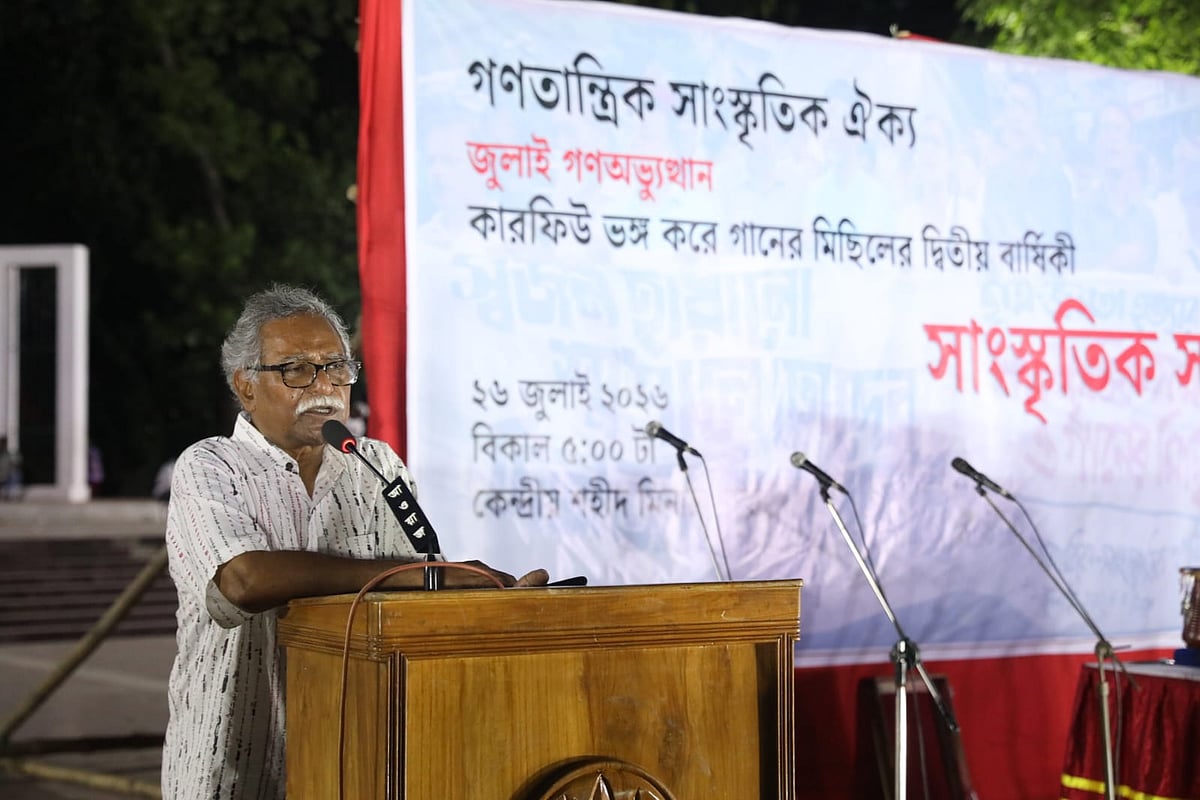
Economist Anu Muhammad has stated that the achievements of the July mass uprising are being reversed, mirroring how the gains of the Liberation War were lost to the people. He believes there is a concerted effort to seize the uprising, initiated by the public, and steer it in the opposite direction. Muhammad made these remarks during a cultural gathering commemorating the second anniversary of a song procession held during the July uprising, which defied curfew orders. The event was organized by the Democratic Cultural Unity at the Central Shaheed Minar premises on a Sunday afternoon. Muhammad, a former economics professor at Jahangirnagar University, noted that while the uprising led to the downfall of an oppressive regime, the aspirations for democratic transformation remain unfulfilled. He highlighted the significant role of artists, writers, and cultural activists in the July movement, describing the song procession as a cultural expression of a broader resistance. Although some in the cultural sphere had previously capitulated to the rulers, many artists and cultural workers maintained their independence and joined protests against killings and repression, thereby broadening the uprising's reach. Muhammad, who was active in the uprising, observed that the post-uprising situation did not progress as anticipated. He recalled the movement's core messages of universal rights, equality, and democratic change, but pointed to subsequent attacks on women, indigenous people, artists, writers, and cultural activities. The trend observed has been contrary to the uprising's potential to foster cultural freedom and democratic development. He further stated that groups politicizing gender, religion, and ethnicity are now attempting to gain influence, giving the impression that they have become the inheritors of the uprising. This effort to usurp the movement, he argued, has been facilitated by the interim government's betrayal of public expectations and the current elected government's tacit approval of various issues.
The commentary suggests a disconnect between the popular will expressed during the July uprising and its subsequent political and social trajectory. This phenomenon, where mass movements fail to translate into sustained democratic gains, can often be attributed to the complex interplay of institutional inertia, the co-option of leadership, and the re-emergence of pre-existing societal divisions. In the context of a post-uprising environment, the challenge lies in establishing robust governance structures that actively safeguard against the erosion of rights and ensure equitable representation, rather than allowing fragmented interests to dominate the narrative. The analysis prompts consideration of how future movements can build mechanisms for accountability and long-term systemic change to prevent a recurrence of this perceived reversal of popular mandate.
AI-generated to prompt reflection — not editorial opinion, not advice, not a statement of fact. How this works.