Electrons: Not Marbles, But Point-Like Quantum Particles
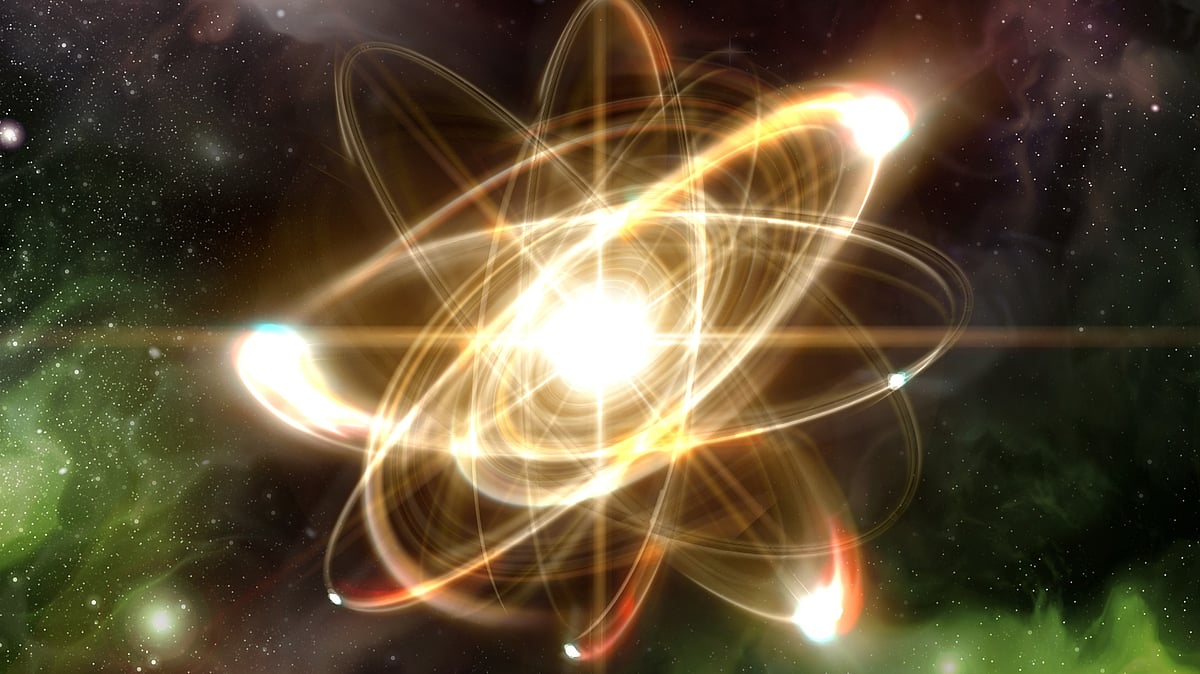
Quantum physics is governed by the uncertainty principle, leading to counterintuitive concepts and prevalent myths. This article, the fifth in a series, debunks the common misconception that electrons are spherical like marbles. While macroscopic objects like planets and water droplets appear spherical due to natural preferences for minimal surface area and surface tension, subatomic particles operate under different rules. Atoms themselves are often considered spherical due to the arrangement of their components. However, the article clarifies that protons and neutrons, which form the atomic nucleus along with charged protons and neutral neutrons, are not fundamental particles. Protons are composed of two up quarks and one down quark, while neutrons consist of two down quarks and one up quark, bound by the strong nuclear force. The idea of these quarks forming a spherical proton or neutron is questioned, as three marbles placed together do not form a sphere. The article traces the discovery of the electron by J.J. Thomson in 1897, before the advent of quantum theory. Thomson determined its negative charge and mass-to-charge ratio, finding its mass to be about 1/1800th of a hydrogen ion's. This discovery preceded the understanding of quarks and other fundamental particles like photons and gluons. Crucially, quantum mechanics defines fundamental particles as 'point-like,' meaning they have zero volume and thus no dimensions like length, width, or height. Therefore, conceptualizing an electron as spherical is fundamentally incorrect. Electrons are also wave-like, as demonstrated by the double-slit experiment, which precludes them from having a fixed shape. The uncertainty principle further complicates defining precise properties like position and size for quantum particles.
The article effectively deconstructs a common analogy used to visualize electrons, highlighting the limitations of classical intuition when applied to quantum phenomena. By contrasting macroscopic spherical objects with the point-like, wave-particle duality of electrons, it underscores the need for a paradigm shift in understanding the subatomic realm. The analysis points to the inherent challenge in reconciling our everyday experience with the probabilistic nature of quantum mechanics, where properties like size and location are not absolute but governed by uncertainty. This exploration serves to inoculate readers against simplistic, potentially misleading, analogies and encourages a deeper appreciation for the abstract mathematical frameworks that accurately describe quantum reality.
AI-generated to prompt reflection — not editorial opinion, not advice, not a statement of fact. How this works.