Erdogan Gifts NATO Leaders Vintage Revolvers, Sparking Security and Customs Questions
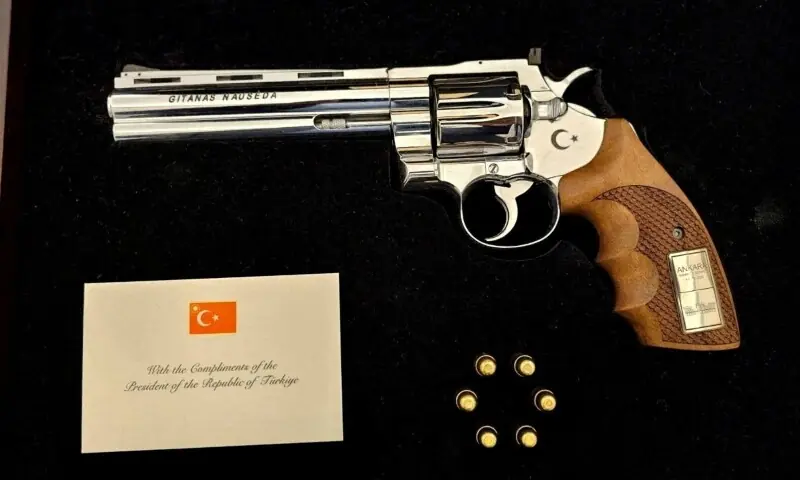
At the recent NATO summit in Ankara, Turkish President Recep Tayyip Erdogan presented an unusual parting gift to attending leaders: vintage revolvers along with live ammunition. The handguns, identified as the Turkish-made Gumusay .357 Magnum, were presented in display boxes featuring national and NATO insignia. This gesture aimed to highlight Turkey's growing defense industry, which has become a significant export and foreign policy tool. While intended as a show of national pride and industrial capability, the gifts have raised practical concerns for the recipients. Belgian Prime Minister Bart De Wever surrendered his firearm to airport police for safekeeping. Polish authorities are awaiting customs clearance for their gifted revolver, emphasizing it will be secured and respected. Some leaders' offices, like those in the Netherlands and Sweden, reported their revolvers were initially stored at their respective embassies in Ankara, with plans for disabling or awaiting import procedures. Britain's Keir Starmer received a revolver with 500 bullets, while Italian Prime Minister Giorgia Meloni's gift is already at the Palazzo Chigi. European Commission President Ursula von der Leyen plans to donate hers to a military museum. Turkey's firearms industry, increasingly competitive in the European civilian market, is noted for its inexpensive pistols and shotguns, though the gifted revolvers are considered collector's items rather than representative of current production, which leans towards semi-automatics. Between 2019 and 2024, Turkey ranked as the world's third-largest exporter of small arms, with approximately $3 billion in exports.
President Erdogan's distribution of functional firearms as diplomatic gifts to NATO leaders serves as a potent demonstration of Turkey's defense industry capabilities and its assertive foreign policy. This action strategically leverages Turkey's growing influence as a global small arms exporter, aiming to enhance its international standing and potentially foster closer defense ties. However, the practical implications of transporting and securing live firearms across international borders highlight the complexities of such unconventional diplomatic gestures. Future statecraft may need to balance symbolic displays of industrial power with established international protocols for arms control and security, particularly as nations increasingly compete in the global defense market. This event underscores the evolving landscape of international relations, where economic and industrial prowess, especially in defense, are becoming increasingly significant tools of soft and hard power projection.
AI-generated to prompt reflection — not editorial opinion, not advice, not a statement of fact. How this works.