Ernest Hemingway: A Life of Adventure, Literature, and Tumult
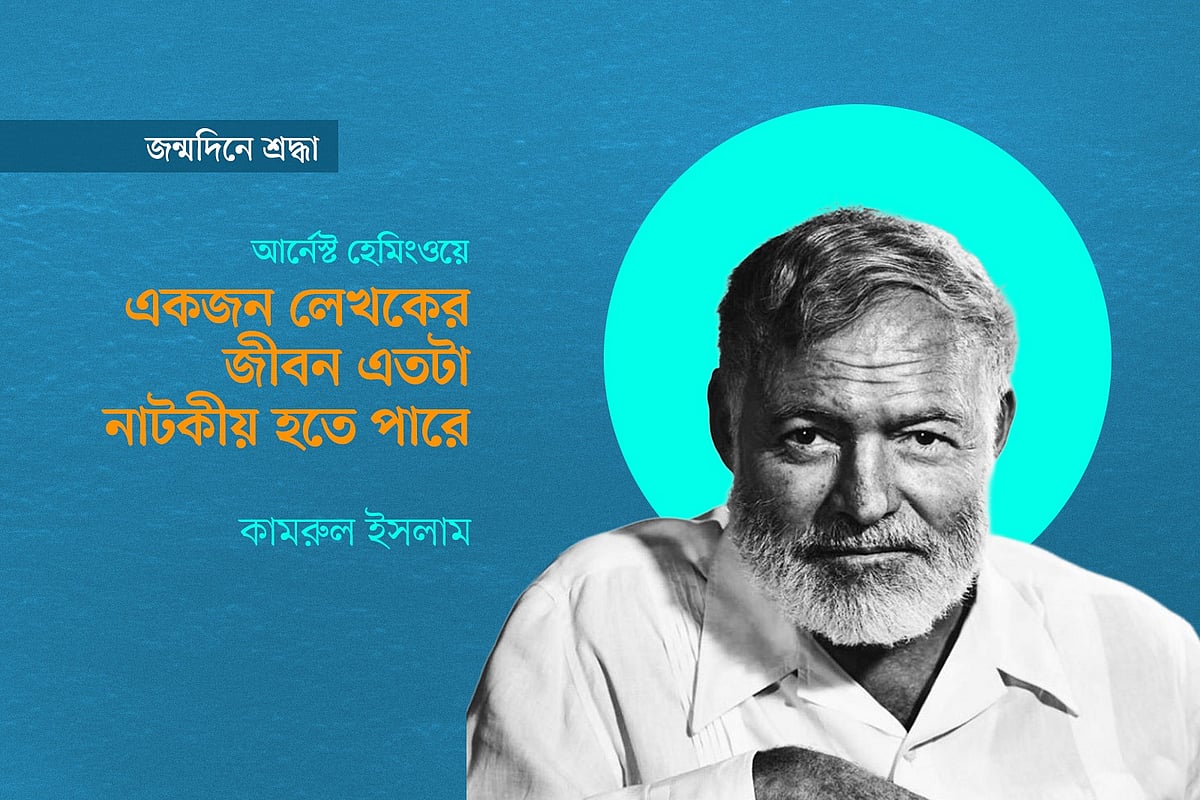
Ernest Hemingway, born July 21, 1899, in Oak Park, Illinois, was a celebrated American novelist whose life was as dramatic and adventurous as his fiction. From a young age, he was drawn to the outdoors, with his father introducing him to fishing and hunting in Michigan. Despite his mother's desire for him to pursue music, Hemingway's father's influence prevailed, shaping his early passion for nature and sport. His education included participation in debating clubs and captaining the water basketball team, alongside developing a reputation as a strong swimmer. Hemingway's literary career began during his school years, focusing on fiction and contributing to literary magazines, while also harboring an interest in sports reporting. He graduated in 1917 and served as a volunteer ambulance driver for the Red Cross with the Italian Army during World War I, an experience that deeply impacted his writing. During his service, he was severely wounded by a mortar shell in Italy, leading to a lengthy hospital stay where he fell in love with Agnes von Kurowsky, an American Red Cross nurse, though their age difference prevented marriage. His early literary success came with the publication of "The Sun Also Rises" in 1926, depicting the disillusioned lives of American expatriates in Paris after World War I, a generation famously dubbed "The Lost Generation" by Gertrude Stein. This was followed by the widely read novel "A Farewell to Arms" in 1929, a tragic love story set during wartime. Hemingway's personal life was marked by multiple marriages; he divorced his first wife, Hadley Richardson, whom he married in 1921, and later married Pauline Pfeiffer in 1927. He lived in Key West, Florida, from 1928 to 1937, gaining renown as a sportsman. His novel "Green Hills of Africa" was published in 1935. Hemingway actively supported the Republican cause during the Spanish Civil War, even making a documentary film, "The Spanish Earth." He met Martha Gellhorn, a correspondent for Collier's magazine, during this period, and they married in 1940 after his divorce from Pfeiffer. He was also influenced by various art forms, drawing inspiration from painters like Paul Cézanne for landscape descriptions and from composer Johann Sebastian Bach for artistic harmony. His experiences during World War II led to further writing, including "For Whom the Bell Tolls" (1940), based on his time as a journalist on the front lines. After the war, he moved to Cuba, where he lived with his fourth wife, Mary Welsh, whom he married in 1946. Despite critical reception of his later novel "Across the River and Into the Trees" (1950), Hemingway continued to live an adventurous life, engaging in fishing and other pursuits. He received the Pulitzer Prize in 1953 and the Nobel Prize in Literature in 1954 for "The Old Man and the Sea," a novella published in 1952 that brought him renewed acclaim. He acknowledged influences from authors like Mark Twain, learning from "Adventures of Huckleberry Finn" how to capture authentic American dialogue.
Ernest Hemingway's life story exemplifies a profound interplay between personal experience and literary output, demonstrating how a writer's engagement with diverse and often perilous environments can shape their narrative voice. His career trajectory, marked by critical successes like "The Old Man and the Sea" and "A Farewell to Arms," alongside periods of critical disapproval, highlights the volatile nature of literary reception and the enduring challenge of maintaining artistic relevance. Hemingway's embrace of adventure—from wartime reporting to big-game hunting and deep-sea fishing—suggests a deliberate cultivation of a persona that blurred the lines between author and protagonist, potentially serving as both a source of inspiration and a complex personal burden. Examining his life through the lens of the next decade, his relentless pursuit of intense experiences and his often tumultuous personal relationships offer insights into the psychological demands of a life lived publicly and intensely, and the potential for such a life to both fuel and ultimately strain creative output. The narrative also implicitly raises questions about the sustainability of such a high-octane existence and the societal structures that both enable and challenge individuals who operate at such extremes.
AI-generated to prompt reflection — not editorial opinion, not advice, not a statement of fact. How this works.