EU Demands US Adhere to Trade Deal Amid New Trump Tariffs
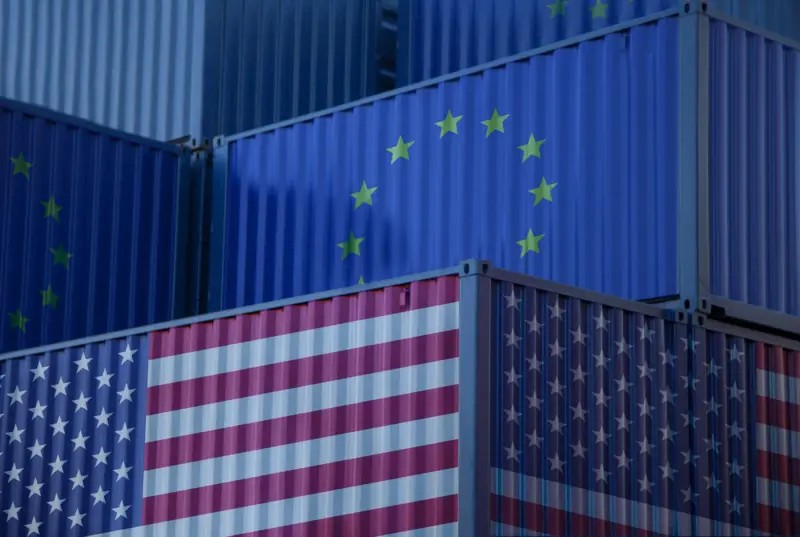
The European Union (EU) has stated its expectation that the United States will fully honor their trade agreement, which took effect on July 1st. This call comes after the Trump administration announced new tariffs on imported goods, citing concerns about forced labor in global supply chains. The EU's statement followed the U.S. imposition of a 12.5% tariff on products from Brazil and other trading partners, including the EU itself. This new tariff could raise the total tariff on some Brazilian exports to 37.5%, in addition to previously announced tariffs.
A European Commission spokesperson confirmed that the EU has met its obligations under the trade agreement with Washington and intends to continue dialogue with the U.S. administration. The EU's demand for adherence to the agreement occurs just over a month after the European Parliament approved a reduction in import tariffs on various American products, fulfilling its part of a trade deal finalized the previous year. This understanding involved the EU eliminating tariffs on U.S. industrial goods and increasing access for American agricultural products, while the U.S. maintained 15% tariffs on most EU exports.
The U.S. tariffs are linked to an investigation by the Office of the U.S. Trade Representative (USTR), which concluded that several countries lack sufficient mechanisms to prevent products made with forced labor from entering their markets. The U.S. asserts that Brazil, the EU, and numerous other partners inadequately monitor their import chains, creating unfair competition for American companies. However, international experts and officials have contested this justification, noting the absence of concrete cases of Brazilian products made with forced labor identified in the U.S. market. Furthermore, sectors in Brazil often associated with labor exploitation, such as cattle ranching and coffee cultivation, were not targeted by the main surcharges. Some analysts suggest these trade actions are part of a broader U.S. strategy to pressure economic partners, reorganize global production, protect domestic industry, and increase leverage against China and other competitors. Data indicates the U.S. itself has the highest global import value exposed to forced labor risks ($169.6 billion annually), significantly more than Brazil ($5.6 billion in 2023).
The EU's assertion that the U.S. must adhere to their trade agreement, despite the imposition of new tariffs by the Trump administration, highlights a potential conflict between stated policy objectives and trade enforcement mechanisms. While the U.S. cites the prevention of forced labor as justification, the EU and international trade analysts question the evidence and suggest underlying protectionist motives or geopolitical strategies may be at play. The discrepancy in import values associated with forced labor risks between the U.S. and Brazil, as indicated by data, raises questions about the targeted nature of the tariffs. This situation underscores the complex interplay of national security, economic competitiveness, and ethical supply chain management in international trade relations. Future trade dynamics may increasingly involve scrutiny of domestic practices alongside reciprocal obligations, potentially leading to more intricate dispute resolution processes and a re-evaluation of global supply chain governance frameworks.
AI-generated to prompt reflection — not editorial opinion, not advice, not a statement of fact. How this works.