Euclid Telescope Discovers 31 Early Universe Quasars, Including Two Record-Breaking Distant Ones
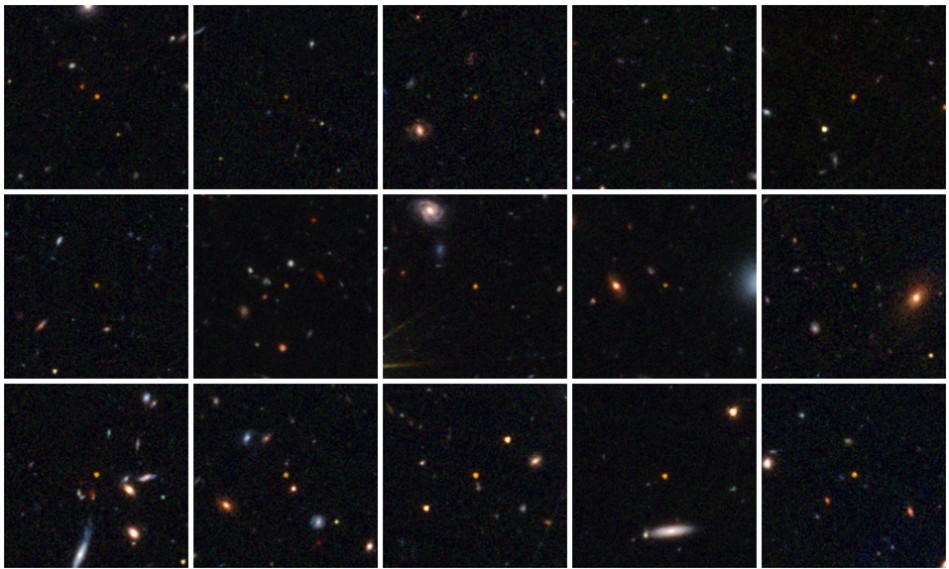
The European Space Agency's (ESA) Euclid space telescope has achieved a significant scientific milestone by identifying 31 primitive galactic nuclei, known as quasars, that existed when the universe was only about 5% of its current age. Among these discoveries are the two most ancient and distant quasars ever recorded, dating back approximately 13 billion years. Utilizing its advanced infrared observation technology, the Euclid observatory successfully conducted this population survey, overcoming previous limitations that only allowed for the detection of the brightest quasars. These findings, published in the journal Astronomy & Astrophysics, represent a major step forward in understanding the early universe.
Two of the 31 discovered quasars, powered by supermassive black holes, shone with the intensity of a trillion suns when the universe was merely 670 million years old. Quasars represent a transient phase in a galaxy's life, characterized by vast amounts of matter spiraling into a central supermassive black hole, releasing immense energy. This process makes the galactic nucleus brighter than any other object in the universe, often outshining its host galaxy by hundreds or thousands of times. Scientists have long sought these early quasars for their valuable insights into the cosmos's infancy, including the formation of the first supermassive black holes and galaxies. However, these early galactic nuclei are exceptionally rare and difficult to detect due to their faint primordial light and the limited time for galaxies to grow to sufficient size.
The Euclid telescope, launched in 2023, is exploring this enigmatic period of cosmic history. Daming Yang, lead author of the study from Leiden University, stated that analyzing these objects helps in understanding how such massive systems formed and grew so rapidly, a key mystery in astrophysics. Joseph Hennawi of Leiden University and UC Santa Barbara noted that these quasars provide crucial clues to understanding the formation of supermassive black holes, which already existed in the early universe with masses billions of times that of the Sun, and whose rapid growth remains poorly understood.
The Euclid mission's discovery of 31 early quasars, including two record-breakers in distance and age, offers a unique empirical dataset for astrophysical models of galaxy and supermassive black hole formation. By detecting fainter objects than previously possible, Euclid is pushing the observational frontier into the cosmic dawn, providing direct evidence of the conditions and processes that shaped the early universe. This advancement allows for rigorous testing of theories regarding the rapid growth of early black holes and the co-evolution of galaxies, potentially revealing discrepancies between theoretical predictions and observed phenomena. Understanding these early cosmic structures is critical for a comprehensive picture of universal evolution, informing our models of structure formation and the timeline of cosmic reionization over the next decade.
AI-generated to prompt reflection — not editorial opinion, not advice, not a statement of fact. How this works.