Euclid Telescope Discovers Oldest Quasars, Illuminating Early Universe Mysteries
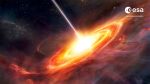
The Euclid space telescope has identified 31 quasars located in the early universe. Among these discoveries, two quasars are particularly significant as they were already shining within the first 670 million years following the Big Bang. This finding provides new insights into the conditions and evolution of the cosmos during its nascent stages. Quasars are extremely luminous active galactic nuclei, powered by supermassive black holes feeding on surrounding matter. Their presence so early in the universe challenges existing models of galaxy formation and black hole growth. The Euclid mission aims to map the dark Universe, but its instruments are also proving valuable for studying the early cosmic structures. The detection of these ancient quasars offers a unique opportunity to probe the epoch of reionization, a critical period when the universe transitioned from a neutral state to an ionized one. Further analysis of these objects could help astronomers understand the processes that led to the formation of the first stars and galaxies.
The discovery of these exceptionally early quasars by the Euclid telescope presents a valuable data point for cosmological models. By observing phenomena that occurred within the first 670 million years after the Big Bang, scientists can refine theories regarding the formation and evolution of supermassive black holes and the galaxies they inhabit. This data may help resolve discrepancies between observed early structures and predictions from current simulations, potentially indicating a need to adjust our understanding of the universe's initial conditions or the rate at which early structures could form and grow. The findings underscore the importance of advanced observational instruments in pushing the boundaries of our cosmic knowledge and prompting revisions to established scientific frameworks.
AI-generated to prompt reflection — not editorial opinion, not advice, not a statement of fact. How this works.