Explore the Cosmos: Free Web Tools for Stargazing and Satellite Tracking
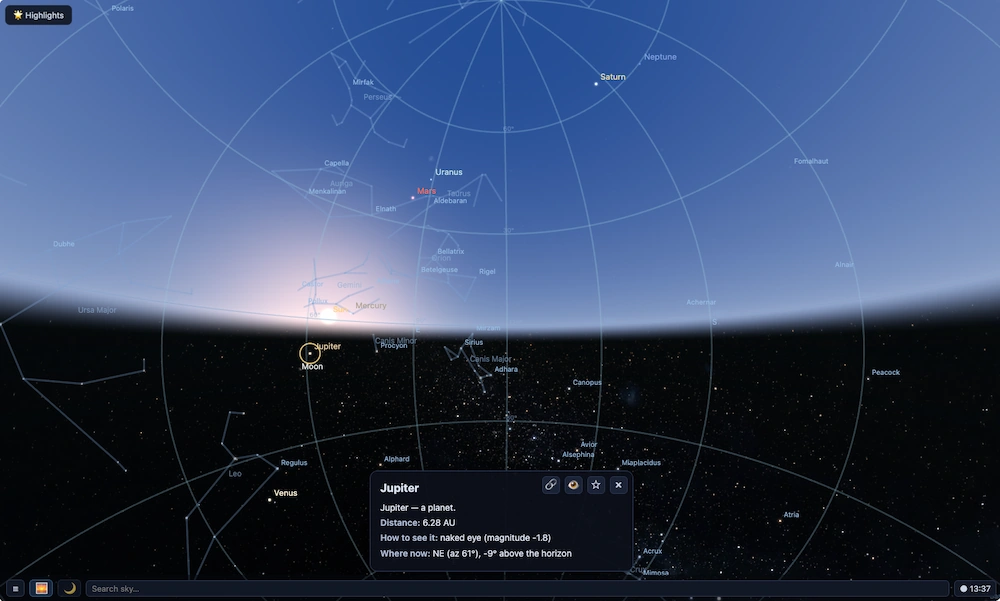
Two free web-based projects, Cosmodial Sky Atlas and SatelliteMap.space, transform browsers into interactive celestial observatories, offering users a "planetarium" experience. These tools are ideal for observing the night sky, especially during clear summer evenings. Cosmodial Sky Atlas functions like a traditional planetarium, featuring a vast database of celestial objects with detailed information available at a click. It allows users to view the sky from any Earth location, simulate past or future centuries, search for objects, track eclipses, identify constellations, and locate the International Space Station (ISS) and China's Tiangong space station. The atlas offers both panoramic and telescope-like views, encompassing 101,263 stars (464 named), the Sun, Moon, seven planets, Pluto, 16 natural satellites, 30 deep-sky objects, notable comets, and three known interstellar visitors. It operates as a web application and functions offline once loaded.
SatelliteMap.space focuses on artificial satellites orbiting Earth, utilizing data from Space-Track and other sources to visualize their 3D trajectories and track space stations, including those from Starlink and smaller companies. It also displays aircraft flights tracked via ADS-B, atmospheric re-entries, and potential satellite collisions. The platform reportedly includes an augmented reality mode and tools for identifying satellite trails in astronomical photos. Users can search for transits across the Moon, where satellites and planes become briefly visible. Additional features include a "time travel" mode for observing celestial events in any past or future date, augmented reality overlays, 3D visualizations from various perspectives (Earth, space, or satellite), and live tracking of the ISS and Tiangong. Both applications are progressive web apps (PWAs) and require no installation, functioning directly within the browser.
These interactive celestial mapping tools democratize astronomical observation, providing accessible, data-rich platforms for both casual stargazers and citizen scientists. By leveraging open data and web technologies, they bypass traditional barriers to entry, such as expensive equipment or specialized software. The dual focus on natural celestial bodies and artificial satellites highlights the increasing human presence in near-Earth space and the associated complexities of orbital management. As the number of satellites, including large constellations, continues to grow, tools like these will become crucial for public awareness and potentially for monitoring orbital traffic and light pollution impacts. Future iterations could integrate more advanced data streams, fostering greater public engagement with space exploration and orbital sustainability challenges.
AI-generated to prompt reflection — not editorial opinion, not advice, not a statement of fact. How this works.