Fazlur Rehman Refuses to Apologize for Remarks on Security Personnel
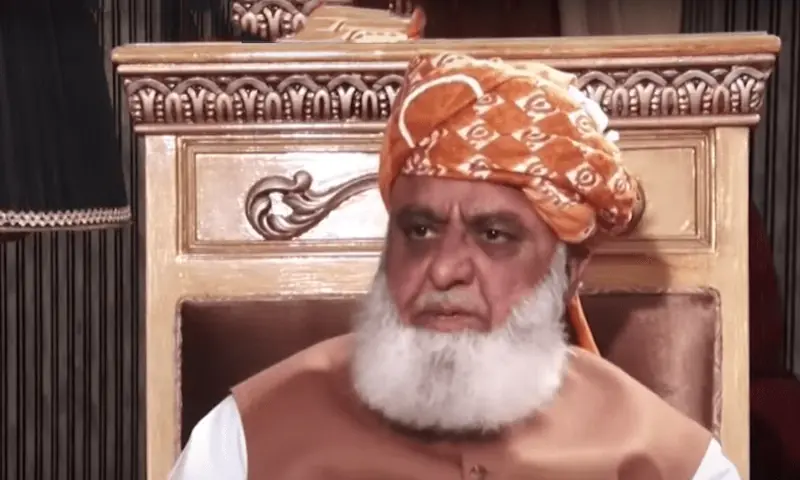
Maulana Fazlur Rehman, chief of the Jamiat Ulema-e-Islam-F (JUI-F), has refused to apologize for his recent controversial remarks concerning security personnel. Speaking at a party lawyers' convention in Islamabad on Sunday, July 20th, 2026, Rehman stated that his criticism was not directed at state institutions but rather at those in leadership positions. He asserted that he has the utmost respect for martyrs and their sacrifices, noting that many of his own comrades have fallen victim to terrorism. Rehman believes his comments, made at a political gathering in Kasur last week, have been misconstrued as part of a propaganda campaign against him and his party. He clarified that his intention was to remind the security institution of its responsibilities and to ensure it operates within its constitutional jurisdiction. The JUI-F leader emphasized that a difference of opinion should not be interpreted as enmity towards the state and that facts cannot be altered by vilification. He also highlighted the importance of constitutional supremacy and institutional respect tied to constitutional roles. Furthermore, Rehman addressed the delay in registering religious seminaries, noting an agreement from 2004-2005 with no subsequent progress. He also claimed the current government is a result of electoral rigging and revealed that his party declined offers to join the government in Balochistan and replace PTI in Khyber Pakhtunkhwa. Finally, he called for an in-camera parliamentary session to discuss the rising terrorism in southern Khyber Pakhtunkhwa districts.
Maulana Fazlur Rehman's stance highlights a recurring tension in political discourse regarding the boundaries of criticism towards state institutions, particularly security forces. His assertion that criticism of policy or leadership is distinct from disloyalty to the state frames the debate around accountability and institutional roles. From a governance perspective, clear communication channels and defined accountability mechanisms are crucial for maintaining public trust and ensuring that security apparatuses operate effectively within their mandates. The challenge lies in distinguishing between constructive critique, necessary for policy refinement and public oversight, and rhetoric that could be perceived as undermining national security or institutional integrity. In the context of evolving geopolitical landscapes and internal security challenges, fostering an environment where legitimate concerns can be raised without fear of reprisal, while simultaneously upholding the operational effectiveness and morale of security personnel, represents a critical balancing act for any nation.
AI-generated to prompt reflection — not editorial opinion, not advice, not a statement of fact. How this works.