Flávio Bolsonaro Urges US to Delay Tariffs, Citing Political Uncertainty
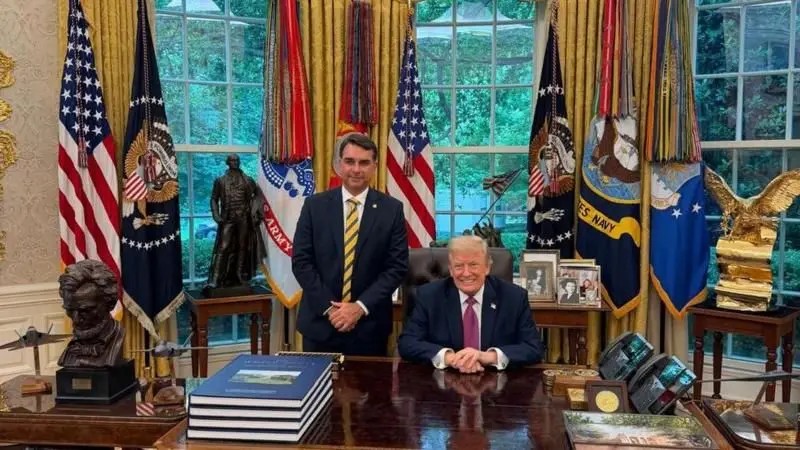
Senator Flávio Bolsonaro, a presidential pre-candidate for the PL party, addressed a public hearing in the United States on Tuesday, August 7th, regarding proposed new tariffs on Brazilian products. Speaking in English and accompanied by his brother, former congressman Eduardo Bolsonaro, Flávio argued that the timing for imposing these tariffs is "the worst possible." He emphasized that Brazil is just 90 days away from its presidential elections in October, and the country's political landscape would be significantly altered by such a measure, making it difficult to reverse. Bolsonaro advocated for a postponement of the decision, highlighting the potential for instability. The deadline for the U.S. to decide on additional tariffs on Brazilian goods is July 15th. Flávio Bolsonaro secured a speaking slot at the USTR public hearing by submitting a request and a summary of his intended remarks, asking for the standard five minutes to speak in person. He presented himself as a member of the Brazilian Federal Senate and a presidential pre-candidate, noting a previous meeting with then-President Trump at the White House in late May to discuss related matters.
Senator Bolsonaro's plea to delay U.S. tariffs highlights the complex interplay between international trade policy and domestic political cycles. From a U.S. perspective, the timing of tariff implementation is often driven by strategic economic objectives, but domestic political considerations, such as upcoming elections in partner countries, can introduce significant uncertainty. The senator's argument suggests that imposing tariffs immediately before Brazil's presidential elections could create unpredictable market reactions and complicate future bilateral trade negotiations, regardless of the election outcome. This situation underscores the need for trade policy frameworks that account for geopolitical stability and electoral calendars to foster more predictable and sustainable international economic relations, particularly in the lead-up to a decade shaped by evolving global trade dynamics and technological competition.
AI-generated to prompt reflection — not editorial opinion, not advice, not a statement of fact. How this works.