Forhad Mazhar: Awami League will persist as long as Jamaat-e-Islami exists in politics
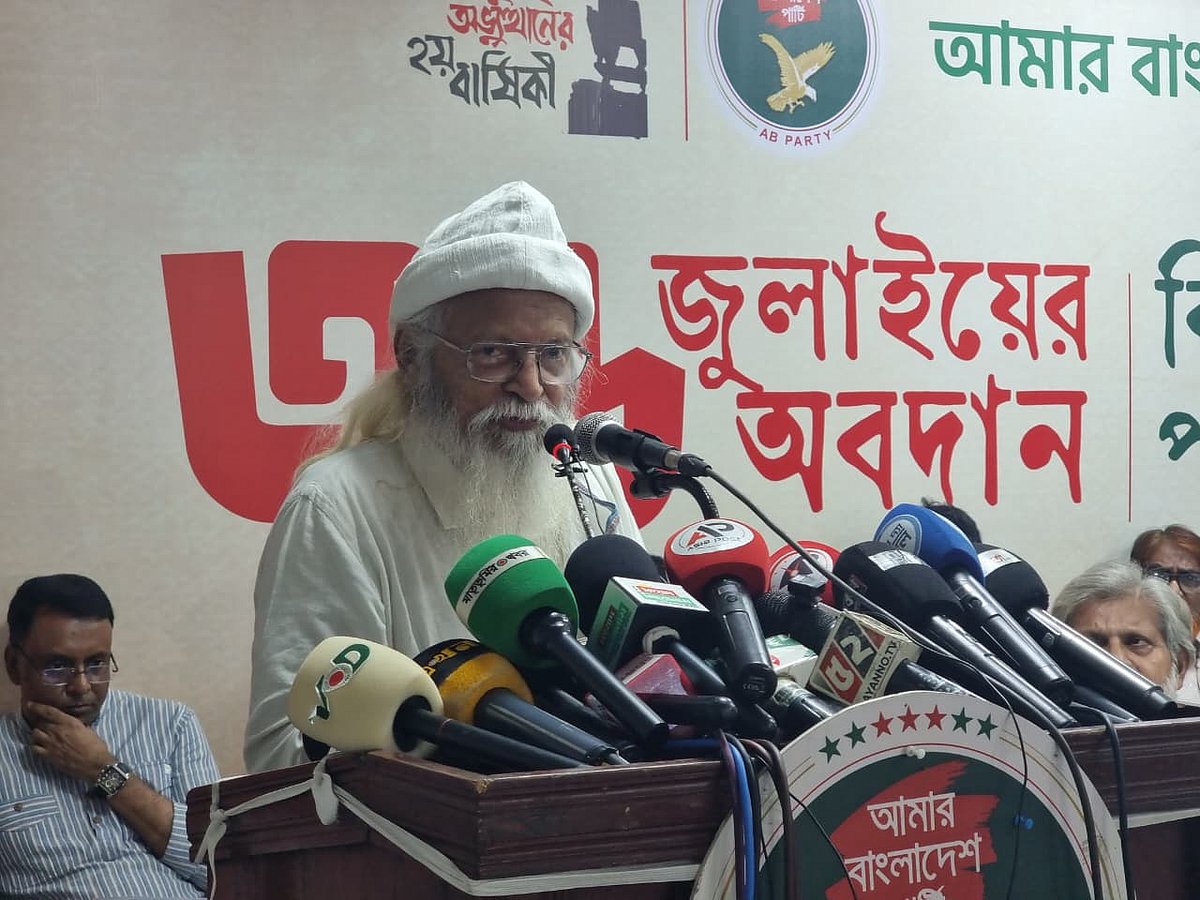
Poet, thinker, and political analyst Forhad Mazhar stated that the Awami League will continue to exist in Bangladesh's politics as long as Jamaat-e-Islami remains a political entity. Mazhar expressed strong opposition to Jamaat-e-Islami participating in politics under its current name, arguing that while Islam is a vital part of their faith, its principles are crucial for building a new state and society. He also called for the complete abolition of the 1972 constitution, deeming it a colonial 'weapon' used against popular sovereignty. Mazhar advocates for the creation of a new 'constitution' and the establishment of popular sovereignty as the sole path to rebuilding Bangladesh. He made these remarks on Sunday at the Dhaka Reporters Unity (DRU) during a dialogue organized by his party, Amar Bangladesh (AB) Party, titled 'Evaluating the Contributions, Debates, and Failures of July 36'.
Mazhar emphasized the historical significance of the 1971 Liberation War, asserting that Bangladesh emerged as a distinct political entity and this achievement should not be compromised, even with Jamaat-e-Islami. He criticized the seventh article of the 1972 constitution, stating that while it declares the people as the source of state power, it subsequently elevates the constitution and legal documents above the people, negating their sovereignty. He drew parallels to the Legal Framework Order (LFO) during West Pakistani rule, where winners of elections imposed a constitution. Mazhar distinguished between a 'constitution' and a 'governance structure,' defining the latter as a framework created by the people to manage ownership, finance, trade, healthcare, and education, asserting that people are above any constitution and can create a new governance structure at will. He also criticized the post-August 5, 2025, power transition process, alleging that a fully empowered interim government, ideally led by Professor Muhammad Yunus, was prevented by the then-army chief, President Mohammed Shahabuddin, and the BNP, calling the subsequent government a 'constitutional counter-revolution.' He also critiqued the media for mischaracterizing this government as interim, when it was a presidential, military-backed advisory council under the old constitution, incapable of fundamental change. Mazhar praised the youth's bravery in the recent uprising but cautioned against police brutality and urged Tarique Rahman not to betray the youth, noting that Begum Khaleda Zia also never intended to betray them. He condemned acts of religious extremism, such as vandalizing shrines, comparing it to aggression like turning Gaza into real estate, and rejected any claim of exclusive authority over Islam. He rejected the notion that the recent uprising was a failure, highlighting the restored freedom of speech and Sheikh Hasina's departure as significant achievements, urging focus on future tasks rather than dwelling on past setbacks.
The political commentary highlights a persistent tension between established political parties and emerging movements in Bangladesh. The critique of the 1972 constitution and the call for a new 'governance structure' reflect a desire for a fundamental shift in the nation's political framework, moving away from what is perceived as colonial or imposed legal systems towards a more democratically derived order. The analysis of the post-uprising power transition suggests a struggle over the direction of governance, with different factions vying for influence. The commentary also touches upon the complex role of religion in politics and the potential for its manipulation, contrasting genuine religious principles with their instrumentalization for power. The emphasis on youth agency and the call for accountability from political leaders point to a dynamic political landscape where popular will is increasingly asserted, challenging traditional power structures and demanding greater transparency and responsiveness from institutions.
AI-generated to prompt reflection — not editorial opinion, not advice, not a statement of fact. How this works.