Former Chief Prosecutor: Government's claims against July Charter are legally baseless
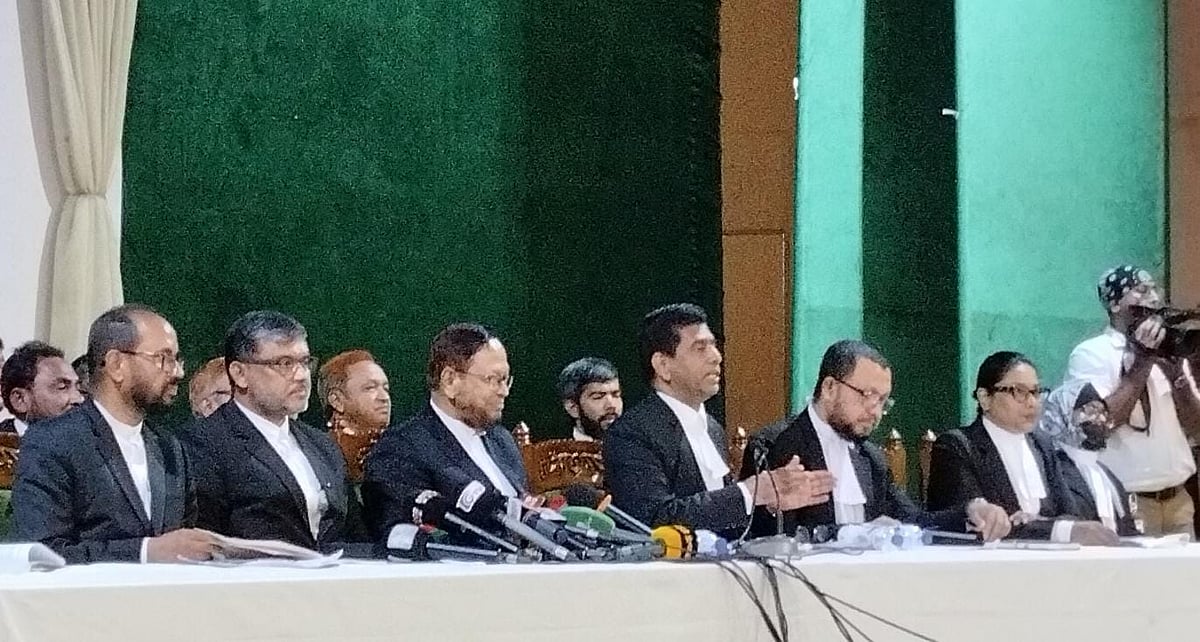
Mohammad Tajul Islam, former Chief Prosecutor of the International Crimes Tribunal, stated that the ruling party's claim in Parliament that the July National Charter implementation order is unconstitutional is legally unfounded. He argued that the government accepts the order when it aligns with their interests but declares it unconstitutional and creates legal disputes when it does not, calling this political hypocrisy. Tajul Islam made these remarks on Thursday at a press conference organized by the Bangladesh Lawyers' Council at the Supreme Court Bar Association auditorium. The event's theme was 'Constitutional Reform, Referendum, July Charter, Fifth Amendment Case Verdict, and the Future of Democracy in the Current Reality.'
He explained that the interim government formed after the July uprising decided to reconstruct the state through an All-Party Consensus Commission. This decision led to a consensus on a referendum and reforms, and the July Charter implementation order was issued to provide legal coverage for these actions. Tajul Islam questioned the legitimacy of current Members of Parliament if the July Charter implementation order is deemed illegal, emphasizing that revolutions do not adhere to existing constitutions and that the people are the source of all legitimacy. Citing Article 7 of the Constitution, which states that the people are the source of all power and the constitution is an expression of their will, he asserted that the nearly 70% public vote in favor of this transformation makes the July Charter's implementation fully legal. He further clarified, citing international legal precedents, that even the Supreme Court has no authority to rule against decisions made by popular will during a revolution, suggesting a group is creating unnecessary controversy for political gain.
Senior Supreme Court lawyer Mohammad Shishir Monir presented a written statement, asserting that the July National Charter was created to fulfill the public aspirations expressed through the July uprising, making the prompt implementation of the referendum's verdict and constitutional reforms crucial. He warned that disregarding the referendum's outcome and proposing alternatives would render it meaningless. He also stated that devaluing law in this manner diminishes Parliament's dignity, and if Parliament unilaterally declares things unconstitutional based on majority rule without court rulings, it would be detrimental to the country. He advised that any objections should be addressed through legal cases and specific court decisions. Jamaat-e-Islami Member of Parliament Najibur Rahman, when asked why the opposition did not nominate members to the parliamentary constitutional amendment committee, responded that they oppose constitutional amendment itself and seek reform, not amendment. He characterized the government's actions of speaking of July Charter implementation while forming a new amendment committee as a planned tactic to undermine the July Charter.
The government's challenge to the July Charter's constitutionality, as articulated by former Chief Prosecutor Mohammad Tajul Islam, highlights a recurring tension between political expediency and legal frameworks in Bangladesh. The argument presented suggests that the ruling party may be selectively applying constitutional principles to serve its immediate political interests, potentially undermining the rule of law and public trust. This situation raises questions about governance structures and the mechanisms for resolving disputes when legislative actions are perceived to conflict with popular mandates or foundational legal documents. The analysis points to a potential systemic issue where political actors might prioritize short-term gains over consistent adherence to constitutional processes, which could have long-term implications for democratic stability and the perceived legitimacy of state institutions. The core issue appears to be the interpretation and application of constitutional authority, particularly in the context of post-revolutionary reforms and popular referendums, and how these are navigated within the existing political and legal landscape.
AI-generated to prompt reflection — not editorial opinion, not advice, not a statement of fact. How this works.