Former Editor Criticizes 'Revolutionaries' Decision to Join Interim Government
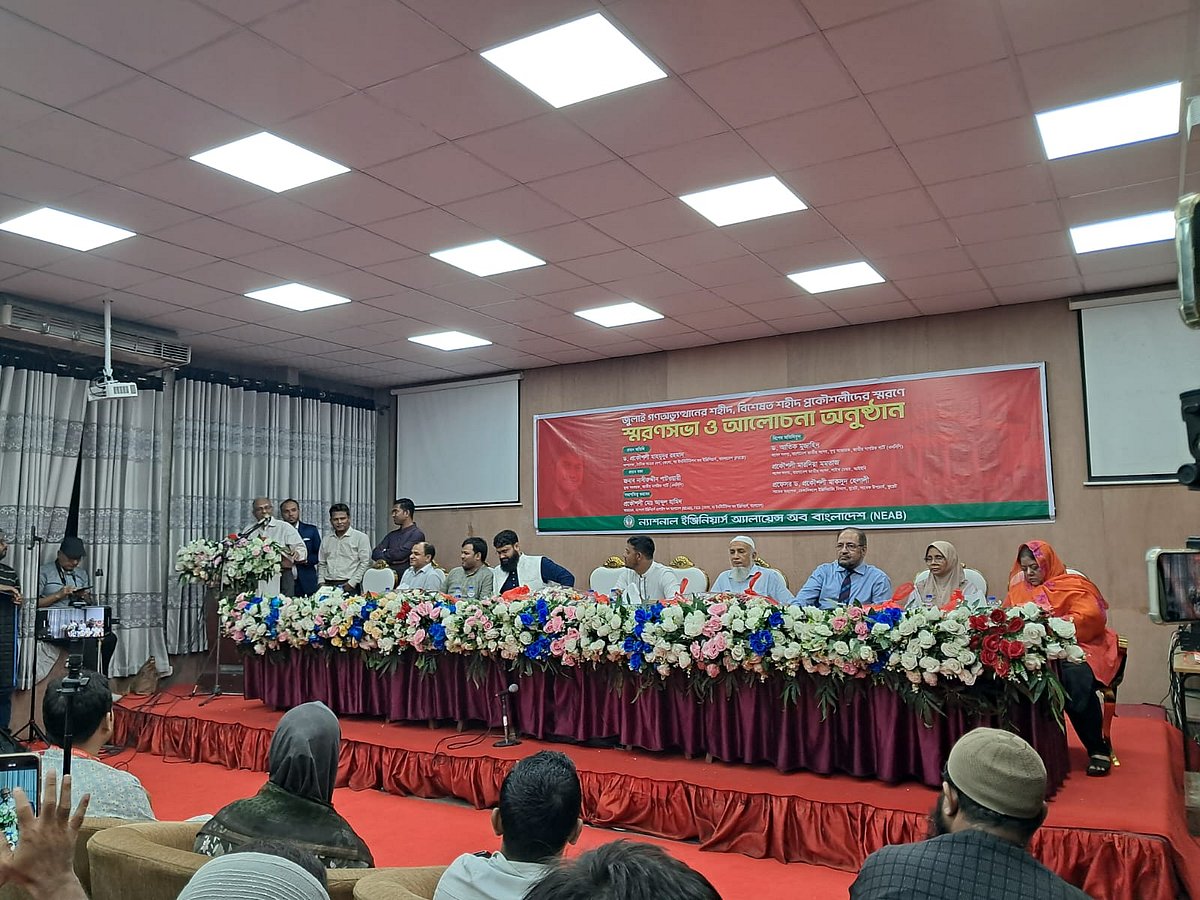
Mahmudur Rahman, editor of the daily Amar Desh newspaper, has stated that the decision by three individuals—Nahid Islam, Asif Mahmud Sajeeb Bhuiyan, and Mahfuz Alam—to join the interim government following the July uprising was a mistake. He believes they should have focused on developing the revolution's ideology and building a revolutionary party from outside the government. Rahman made these remarks on Thursday evening during a discussion event commemorating the martyrs of the July uprising, particularly the engineers. The event was organized by the National Engineers Alliance of Bangladesh (NEAB), an affiliate of the National Citizen Party (NCP), and held at the Institution of Engineers, Bangladesh (IEB) in Dhaka. Rahman argued that the current emboldened actions of those he termed 'accomplices of fascism' stem from the revolutionaries' errors and disunity, with joining the government being the primary misstep. He contrasted this with the Cuban revolution, where revolutionaries collectively formed the government, suggesting that the July revolutionaries' decision to join an established government was flawed. He contended that revolutionaries should articulate the July revolution's philosophy from an external position, as involvement in government brings responsibilities and accountability for both success and failure. Rahman, however, supported the choice of Professor Muhammad Yunus as the head of the interim government, stating that in the given circumstances, there was no viable alternative to lead the government. Abdullahil Aman Azmi, son of Jamaat-e-Islami's former Ameer Ghulam Azam and a former senior military official, announced his intention to launch a 'National Reconciliation Initiative' to encourage non-political, patriotic individuals to urge all parties to cease infighting. Mardia Momtaz, a reserved women's seat MP from Jamaat-e-Islami, criticized the current parliament's lack of independent thought, noting that some MPs vote based on the Chief Whip's direction rather than their own judgment. NCP chief coordinator Nasiruddin Patwari, the main speaker, strongly criticized government activities, particularly concerning privacy, suggesting the government's extensive use of CCTV surveillance infringes on personal privacy.
The commentary by Mahmudur Rahman highlights a fundamental tension in revolutionary movements: the strategic choice between direct participation in governance and maintaining ideological purity and organizational independence from the outside. His critique suggests that joining an existing power structure, even with revolutionary intent, can lead to co-option and dilution of the original goals, potentially resulting in accountability for outcomes without full control. The event also touched upon broader societal concerns regarding political reconciliation and the functioning of parliamentary democracy, with observations on the perceived lack of independent decision-making among some legislators and government surveillance practices. These discussions reflect ongoing debates about the efficacy of different approaches to political change and governance in the region, with implications for future political stability and citizen trust in institutions.
AI-generated to prompt reflection — not editorial opinion, not advice, not a statement of fact. How this works.