Four-Carbon Sugar Detected in Interstellar Space, Hinting at Life's Building Blocks
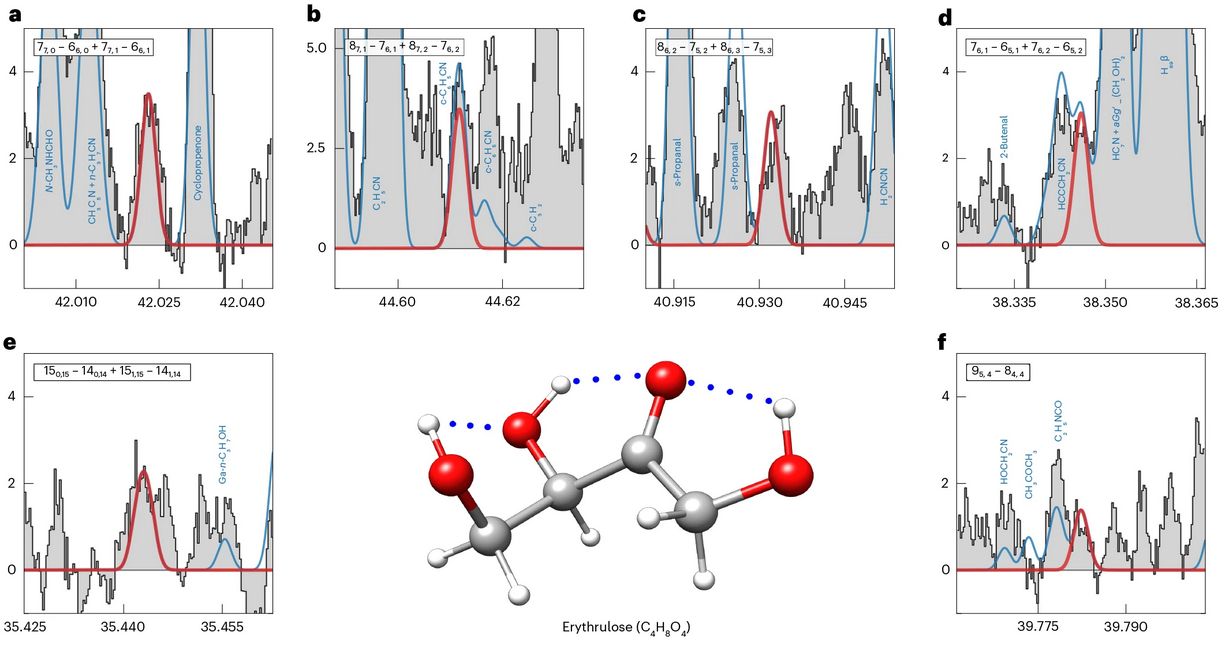
Astronomers have detected a four-carbon sugar, specifically erythrose, in interstellar space for the first time. This discovery was made using the Atacama Large Millimeter/submillimeter Array (ALMA) in Chile. The sugar was found in a star-forming region known as Sagittarius B2 (Sgr B2), a massive molecular cloud located near the center of our Milky Way galaxy. Erythrose is a crucial molecule as it is one of the components of RNA, a molecule essential for life as we know it. The presence of such a complex sugar in space suggests that the fundamental building blocks for life may be readily available in the cosmos. This finding supports the hypothesis that the ingredients for life could have been delivered to early Earth via comets and meteorites. Researchers are optimistic that further observations will reveal the presence of other prebiotic molecules, deepening our understanding of abiogenesis, the process by which life arises from non-living matter. The detection of erythrose is a significant step in the search for extraterrestrial life and the origins of life on Earth.
The detection of a four-carbon sugar in interstellar space represents a significant advancement in astrobiology, providing empirical evidence for the presence of complex organic molecules in environments conducive to planetary formation. This discovery shifts the scientific perspective from theoretical possibility to observational confirmation regarding the cosmic availability of life's precursors. It highlights the potential for prebiotic chemistry to occur on a galactic scale, suggesting that the conditions necessary for life's emergence may not be unique to Earth. Future research will likely focus on identifying a wider spectrum of these molecules and understanding the chemical pathways that lead to their formation and survival in harsh interstellar conditions, thereby refining models of abiogenesis and the potential for life beyond our planet.
AI-generated to prompt reflection — not editorial opinion, not advice, not a statement of fact. How this works.