Four Young Mathematicians Awarded Fields Medals, Math's Highest Honor
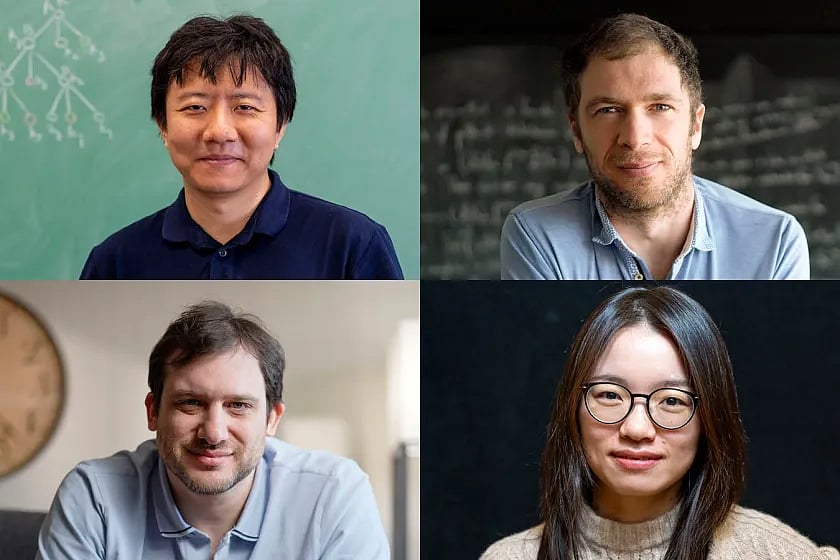
Four exceptionally talented young mathematicians have been honored with the prestigious Fields Medal, often referred to as the Nobel Prize of mathematics. The awards were announced on July 23rd (July 24th Bangladesh time) at the International Congress of Mathematicians held in Philadelphia, Pennsylvania, USA. This award, established in 1936 by Canadian mathematician John Charles Fields, recognizes outstanding achievements by mathematicians under the age of 40 and is presented every four years. This year's recipients have made significant breakthroughs in complex areas of mathematics, tackling problems related to quantum physics, geometry, and topology. Yu Deng from the University of Chicago has bridged the gap between the macroscopic and microscopic worlds in physics by solving a century-old problem posed by David Hilbert concerning the behavior of gases. His work provides a more precise understanding of physical phenomena. Hong Wang of New York University, only the third woman to receive the award in its nearly 90-year history, resolved the 50-year-old Kakeya conjecture. She proved a crucial relationship between the thickness of imagined tubes and the space required to move an object, a breakthrough in 3D geometry. John Pardon from Stony Brook University has advanced the fields of geometry and topology, analyzing knot theory and the complexity of knots on surfaces like donuts. His research also contributes to proving the MNOP conjecture, relevant to understanding quantum string theory. Lastly, Jacob Zimmermann of the University of Toronto has made strides in algebraic geometry with his concept of 'o-minimality,' which simplifies complex models by focusing on their fundamental components. His work brings him closer to solving the famous Hodge conjecture, one of the Millennium Prize Problems offering a $1 million reward.
The awarding of the Fields Medal to these four mathematicians highlights the ongoing evolution of theoretical mathematics and its increasing interconnectedness with fundamental physics and emerging technologies. The recognition of breakthroughs in areas like quantum physics, algebraic geometry, and topology suggests these fields are critical frontiers for future scientific advancement. The focus on young researchers underscores the importance of nurturing emerging talent in a discipline that requires sustained intellectual investment. As these mathematical frameworks are applied to complex challenges in AI, cosmology, and materials science, their societal impact is likely to grow significantly over the next decade, potentially driving innovation across multiple sectors.
AI-generated to prompt reflection — not editorial opinion, not advice, not a statement of fact. How this works.