France Battles Massive Wildfires, Fears 'Fire Dragon' Storms
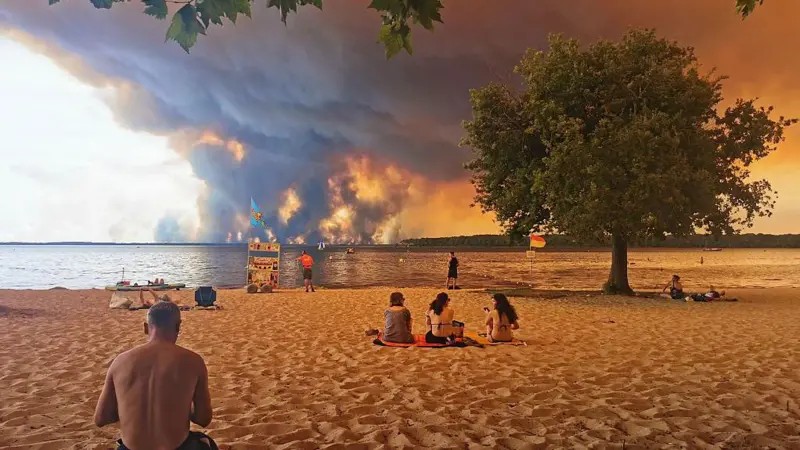
France and central Spain are grappling with severe wildfires, forcing over 325,000 people to evacuate their homes. While fires in Spanish provinces like Ávila and Madrid have been controlled, a new blaze has emerged in the Valencia region. In France, firefighters are struggling to contain one of the largest wildfires in recent years in the Gironde region near Bordeaux. This fire has already devastated approximately 42,000 hectares, marking one of the most significant disasters of its kind since World War II. Amidst the destruction, a striking phenomenon has been observed: a massive cloud formation known as a pyrocumulonimbus, or 'fire cloud,' generated by the intense heat of the wildfire itself. This phenomenon, sometimes called a 'fire dragon cloud' by NASA, is essentially a storm created by the fire, which can complicate firefighting efforts. These intense fires release vast amounts of heat, causing air to rise rapidly, carrying smoke, ash, and water vapor high into the atmosphere. As this air cools, water vapor condenses, forming clouds. If the fire is powerful enough and the atmosphere unstable, these clouds can develop into formidable pyrocumulonimbus clouds, capable of producing lightning, strong winds, hail, and rain. The lightning strikes from these clouds can, in turn, spark new fires, and the unpredictable winds can spread existing flames rapidly. Scientists note that these fire-generated storms are becoming increasingly frequent, with Australia and California having previously recorded similar events. This marks the first time France has explicitly encountered such a phenomenon. Europe, warming at more than twice the global average, faces heightened wildfire risks due to hotter, drier conditions that reduce vegetation moisture. The European Union's Copernicus Climate Change Service indicates that this year's fires in Europe have already consumed more land than the average over the last two decades, with the southern continent expected to face the greatest danger.
The extreme wildfires in France and Spain, exacerbated by a rapidly warming Europe, highlight the escalating impact of climate change on natural disasters. The emergence of pyrocumulonimbus clouds, or 'fire storms,' demonstrates a dangerous feedback loop where intense fires not only destroy ecosystems but also generate meteorological conditions that can intensify and spread the blazes further. This phenomenon underscores the systemic challenges in wildfire management, particularly as climate projections indicate a future with more frequent and severe fire events. The observation that these clouds are becoming more common suggests a need for adaptive strategies in emergency response, potentially incorporating advanced weather prediction and fire behavior modeling. Understanding the complex interplay between climate, vegetation, and atmospheric conditions is crucial for developing long-term resilience and mitigating the devastating consequences of such events.
AI-generated to prompt reflection — not editorial opinion, not advice, not a statement of fact. How this works.