France Battles Unprecedented 'Fire Cloud' Phenomenon During Massive Wildfires
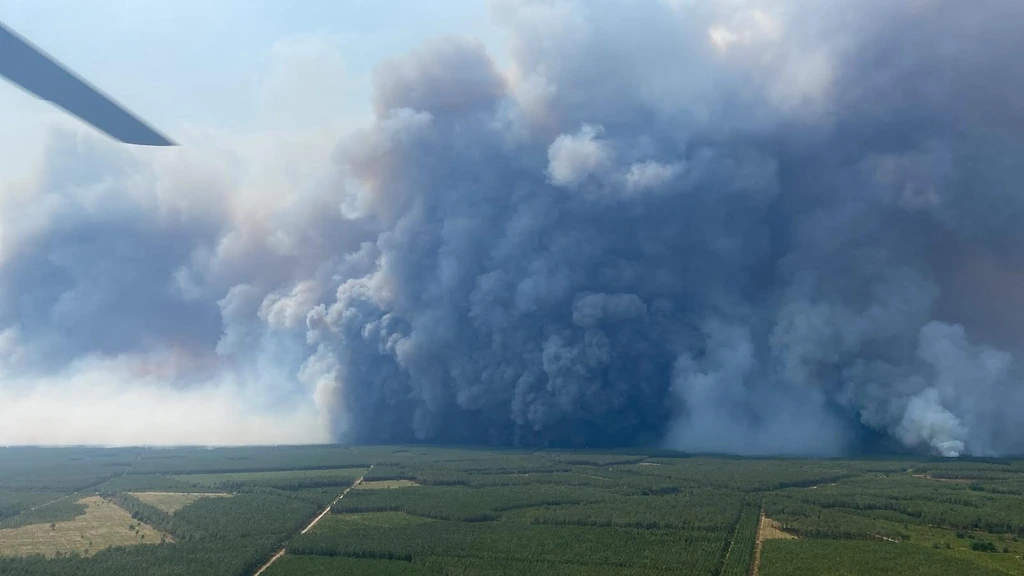
Massive wildfires near Bordeaux, France, have generated a rare and dangerous meteorological event known as a pyrocumulonimbus cloud, or "fire cloud." French firefighters have described the phenomenon as a "firestorm," with the governor of the Gironde department calling it "incredible and unprecedented." These clouds form when extreme heat from a large, intense wildfire causes hot, dry air at ground level to rise rapidly. As this air ascends, it cools and condenses, forming a cloud. The pyrocumulonimbus can generate lightning strikes, which are often accompanied by strong, unpredictable winds and can even spark new fires. While these clouds can produce lightning, they rarely produce rain. Essentially, the wildfire creates its own weather system. The unpredictable winds can exacerbate the ground fire, and lightning poses a significant risk of reignition, as observed in a 2021 event in British Columbia, Canada, where one fire produced over 700,000 lightning flashes. NASA has studied these clouds, with researchers flying through them in 2019 to analyze their chemical composition and impact on air quality and climate. Scientists are actively researching pyrocumulonimbus clouds to develop predictive methods that could aid firefighters. These clouds are exceptionally rare in Europe, requiring a large and powerful fire, and French fire services have not previously recorded one. Similar phenomena have been observed during severe wildfires in Portugal in 2017, and more frequently in Australia and the United States in recent years, typically during the most intense blazes. Experts anticipate that pyrocumulonimbus clouds will become more common in the future due to factors including rising global temperatures, atmospheric changes, and shifting weather patterns, which contribute to more frequent and severe wildfires.
The emergence of pyrocumulonimbus clouds during intense wildfires, as seen in France, highlights the escalating risks associated with extreme weather events. While not directly attributed to climate change, the underlying conditions—longer, drier periods and higher temperatures—are exacerbated by global warming, increasing the likelihood of such severe fires. These self-generating weather systems present a complex challenge for firefighting, as they create their own unpredictable wind patterns and ignition sources. The phenomenon underscores the need for advanced meteorological monitoring and predictive modeling to anticipate and mitigate the impact of these evolving fire dynamics. Future strategies must consider the systemic interplay between climate, atmospheric conditions, and wildfire behavior to enhance resilience and response capabilities in vulnerable regions.
AI-generated to prompt reflection — not editorial opinion, not advice, not a statement of fact. How this works.