France Deploys Airbus A400M Aircraft with Firefighting Kit for First Time
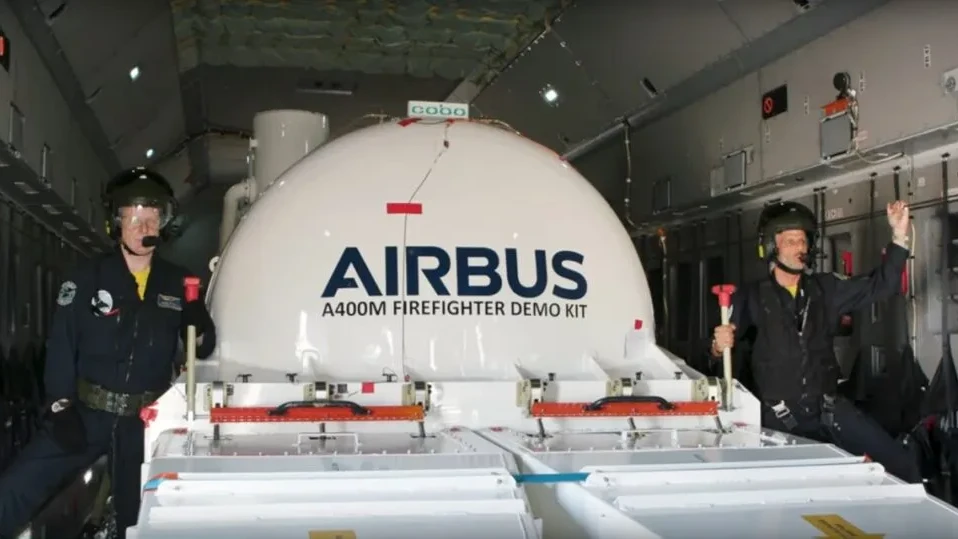
France has utilized its Airbus A400M military transport aircraft equipped with a firefighting kit for the first time to combat a blaze in the Gironde department. The aircraft released 20,000 liters of water and retardant near the fire's edge before returning to the French Air and Space Force base in Istres, located near Marseille. This base, approximately 500 kilometers from the fire, houses the General Armament Directorate's flight testing facilities, where the kit had been undergoing trials for several weeks. The effectiveness of this initial deployment remains unconfirmed, though the operation aimed to create a firebreak. A significant challenge highlighted is the limited availability of the firefighting kits, manufactured by the Spanish company Cobo. Of the two kits produced, only one has reportedly met expected performance standards. These kits are designed to be installed in the cargo hold without modifying the aircraft, allowing the A400M to revert to its standard duties after use. However, Cobo is still working towards becoming a certified Airbus supplier, meaning there is currently a scarcity of these kits for equipping A400M fleets in both France and Spain. Further considerations include the integration of the A400M into existing aerial firefighting operations, given its size and turbulent wake, which necessitate careful spatial and temporal separation from other aircraft. The optimal altitude and speed for water drops are also under scrutiny, with potential issues of evaporation at higher altitudes and damage at lower ones, supported by mixed findings from international studies but also positive assessments from French authorities.
The deployment of the Airbus A400M with a firefighting kit represents an evolving approach to aerial firefighting, leveraging multi-role military assets. The logistical and supply chain challenges for specialized kits, even from established manufacturers, underscore the complexities of rapidly scaling up novel defense or civil-support technologies. Future integration will require careful consideration of operational parameters, including aircraft performance envelopes, atmospheric conditions, and the dynamics of air traffic control in high-stress environments. The effectiveness of such large aircraft in diverse fire conditions, as suggested by varying study outcomes, indicates a need for continued empirical testing and adaptation, potentially leading to specialized operational doctrines rather than a one-size-fits-all application. This development prompts a broader question about the strategic advantage of dual-use military platforms in addressing escalating climate-related emergencies.
AI-generated to prompt reflection — not editorial opinion, not advice, not a statement of fact. How this works.