Free Printable Paper Models of Solar System Bodies Available
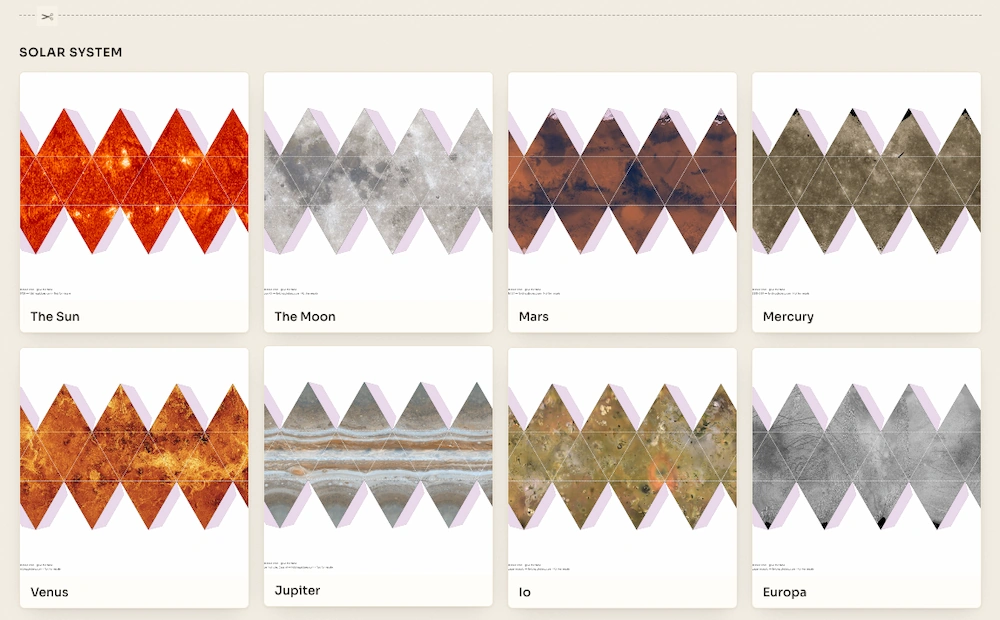
A project called Free Paper Globes offers 26 free printable paper models of solar system bodies, including the Sun, planets, and moons. These models are designed as regular icosahedrons, a favorite geometric shape for the project's creator due to their simple elegance. The templates allow users to cut, fold, and glue the pieces to create 3D representations of celestial objects. In addition to standard planetary models, there are thematic versions of Earth depicting various features like oceans, ice, rain, and biomes. The collection also includes models of Pluto and Ceres. The project, hosted on MapScaping, organizes the templates into four categories. The first category features 10 solar system bodies, including the Sun, Moon, Mercury, Venus, Mars, Jupiter, Pluto, Ceres, and notable moons like Io, Europa, and Titan. The second category presents 11 Earth models with different data layers, such as night views, biomes, population density, and environmental conditions. The third category contains 6 data globes visualizing geographical and scientific information, including seismic activity, meteorite impacts, World Heritage sites, tectonic plates, and time zones. All models utilize open data sources, which are cited for educational and curious purposes, appealing to cartography and geography enthusiasts, as well as students. The templates are available as downloadable A4 or A3 PDFs. While these models are not to scale, they offer an engaging way to explore and learn about our solar system.
This initiative leverages open-source data and accessible papercraft to create educational tools for exploring the solar system. By offering free, printable 3D models, the project democratizes access to astronomical visualization, potentially fostering greater public interest in science and geography. The use of diverse data layers on Earth models highlights the value of geospatial information systems in understanding planetary science and human impact. While the models are not to scale, this limitation presents an opportunity to discuss scientific representation and the challenges of visualizing vast cosmic distances. The project's reliance on open data underscores the growing importance of data sharing in scientific and educational endeavors, promoting transparency and collaborative learning.
AI-generated to prompt reflection — not editorial opinion, not advice, not a statement of fact. How this works.